


Medical Tourism vs. Health Tourism: Understanding the Distinction
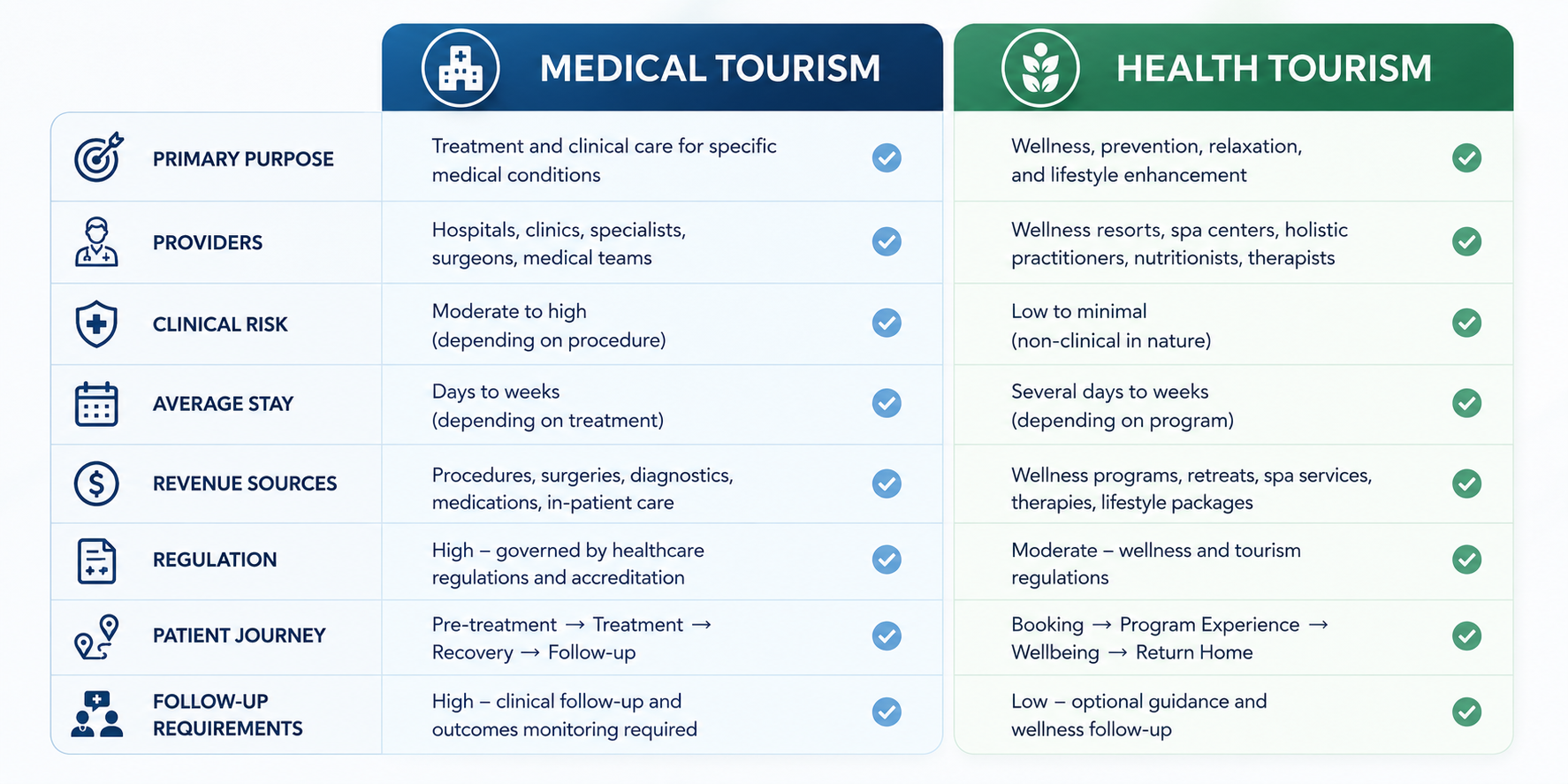
Medical tourism and health tourism are often treated as interchangeable terms, but they represent different patient needs, operating models, risk profiles, and revenue opportunities. Medical tourism centres on clinical diagnosis or treatment, while health tourism is the broader market that can also include prevention, rehabilitation, wellness, thermal therapies, and health-focused travel.

Medical tourism is a clinical segment within the wider health-tourism market
Medical tourism is treatment-led
The primary reason for travel is usually a medical, surgical, dental, diagnostic, fertility, rehabilitation, or specialist service.
Health tourism is broader
It can include medical care, preventive programs, rehabilitation, health screening, thermal treatments, wellness, and health-enhancing travel.
Clinical risk is different
A surgical traveller requires clinical screening, informed consent, infection control, discharge planning, complication management, and aftercare.
Business models differ
Hospitals sell clinical episodes, while health-tourism operators may sell longer experiences involving hospitality, prevention, recovery, and lifestyle services.
Cross-border care is not always tourism
Patients may cross borders through formal referral, reimbursement, diaspora, humanitarian, or regional care arrangements without a tourism component.
Clear terminology builds trust
Accurate labels help patients understand whether an offer is a regulated clinical service, a wellness experience, or a combination of both.
Confusing the categories can create strategic, regulatory, and patient-safety problems.
Research does not use one universally accepted definition for medical, health, and wellness tourism. Reviews of the field describe overlapping terminology and classification systems, with medical tourism generally positioned as treatment-oriented travel and health tourism used as a broader umbrella that can include medical and wellness-related activities [1][2].
The difference has practical consequences. A hospital arranging joint replacement for an international patient carries responsibilities related to clinical eligibility, professional credentials, consent, infection prevention, records, discharge, and follow-up. A destination offering meditation, thermal bathing, nutrition coaching, or a general wellness retreat may operate under a different regulatory and hospitality framework. Combining both under one vague label can leave patients unsure about what is clinically supervised and what is not.
The distinction also affects market measurement. If surgical procedures, preventive check-ups, rehabilitation, spa visits, wellness resorts, and cross-border reimbursed care are counted as one industry, market estimates become difficult to compare. Clear definitions allow hospitals, tourism organizations, policymakers, investors, and patients to evaluate demand more accurately.
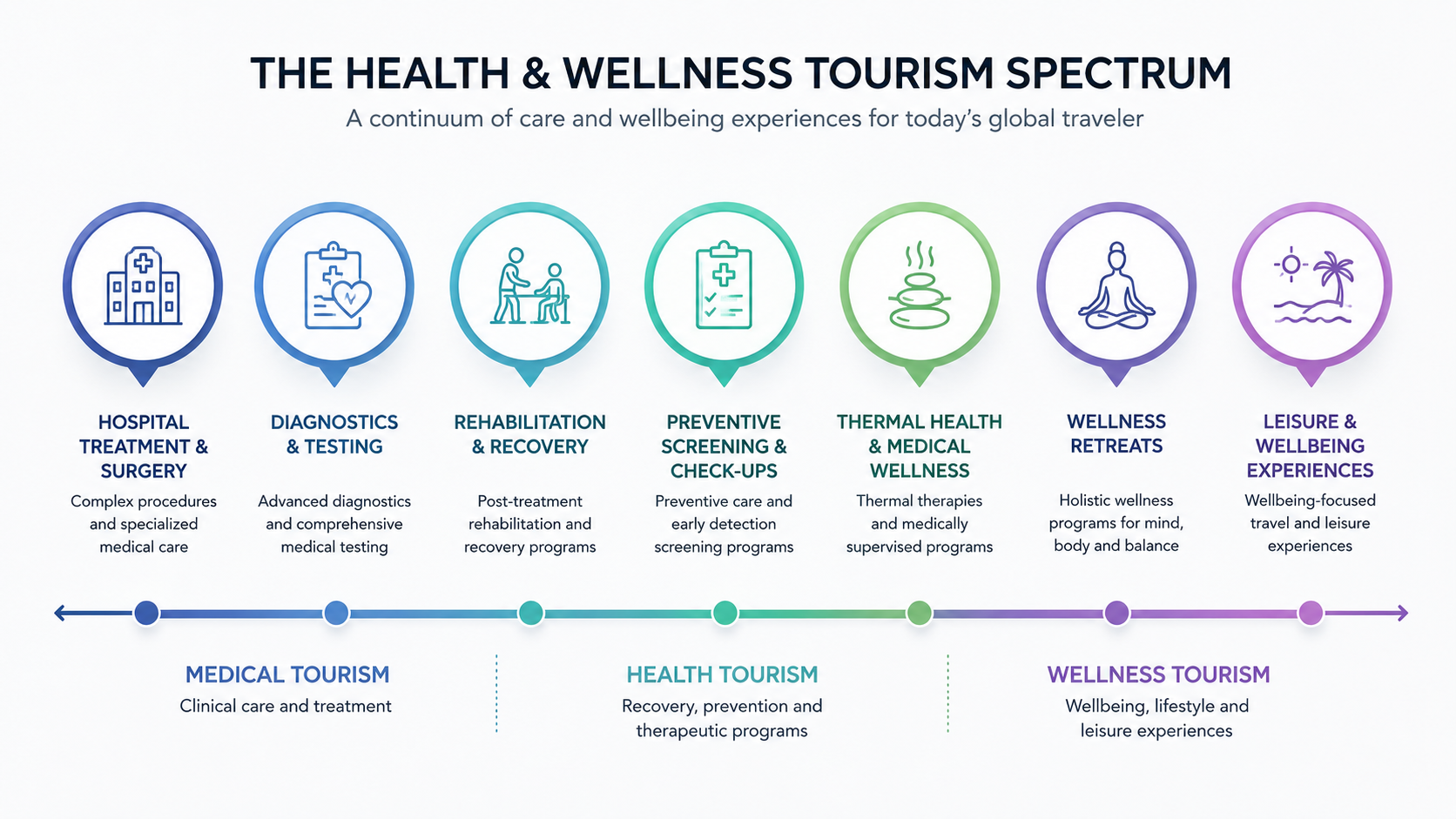
A useful distinction begins with the traveller’s primary purpose
The easiest way to separate medical tourism from health tourism is to ask why the person is travelling. If the primary purpose is to receive a clinical intervention—such as surgery, dental treatment, fertility care, specialist diagnosis, cancer treatment, rehabilitation, or a structured medical examination—the journey generally fits within medical tourism. Travel and hospitality support the episode, but clinical care remains the central product.
Health tourism is usually the wider category. It can include medical tourism, but it may also include prevention, recovery, wellness, thermal or mineral-water treatments, physical conditioning, lifestyle programs, and other activities intended to improve or maintain health. A literature review covering medical, health, and wellness tourism identified these concepts as related but distinct fields shaped by the traveller’s motivation and the intensity of clinical involvement [2].
This does not mean every journey fits neatly into one box. A patient may undergo surgery and then spend two weeks in a medically supported recovery resort. An executive may combine diagnostic screening with nutrition, sleep, and stress-management services. A rehabilitation traveller may receive physician-led therapy while also using hospitality and wellness amenities. The categories overlap, but the underlying clinical obligations should remain clear.
1. Medical tourism begins with a defined clinical need
Medical tourism typically involves intentional travel outside a patient’s usual healthcare environment to obtain planned care. The patient may be seeking lower prices, shorter waits, a specialist, a procedure unavailable at home, perceived higher quality, privacy, or culturally familiar care. The journey normally includes medical-record review, consultation, treatment planning, financial consent, scheduling, travel, intervention, discharge, and post-treatment follow-up.
Because the service is clinical, the provider must be evaluated as a healthcare organization rather than simply as a tourism business. Relevant questions include licensing, professional credentials, clinical outcomes, infection control, anesthesia safety, emergency capacity, medication management, record transfer, complaint processes, and complication coverage. Attractive accommodation and concierge support may improve the experience, but they do not replace clinical governance.
Some researchers prefer the term “medical travel” because many patients do not behave like tourists and may have little interest in leisure activities during a serious episode of care. A World Health Organization Bulletin article noted that the tourism label can be misleading and used “medical traveller” for people crossing borders for treatment [3]. For business communication, either term can be used, but the organization should avoid presenting serious clinical care as an ordinary vacation product.
2. Health tourism includes prevention and wellbeing-oriented travel
Health tourism serves a broader set of goals. Some travellers want to recover function after illness. Others want preventive screening, weight-management support, physiotherapy, healthy-ageing programs, thermal therapies, sleep improvement, stress reduction, or structured lifestyle change. The customer may be healthy, managing a chronic condition, recovering from treatment, or seeking a combination of medical and hospitality services.
This wider market creates opportunities for hospitals, rehabilitation centres, resorts, hospitality companies, public tourism agencies, wellness operators, insurers, and destination-development organizations. OECD analysis has observed renewed interest in tourism experiences focused on health and wellness, particularly as travellers placed greater emphasis on prevention and wellbeing following the pandemic [4].
The commercial model may rely on accommodation nights, program packages, repeat visits, memberships, food and nutrition services, physical activity, spa or thermal services, coaching, diagnostics, and rehabilitation. Compared with a surgical episode, these programs may generate longer stays and more hospitality revenue. They may also face lower clinical intensity, although risk is still present when health claims, medications, chronic conditions, or professional treatments are involved.
3. Wellness tourism is related, but it is not automatically medical care
Wellness tourism generally focuses on maintaining or improving wellbeing rather than diagnosing or treating a specific disease. Typical services may include yoga, meditation, spa therapies, relaxation, fitness, healthy meals, nature-based experiences, or nonclinical coaching. These services can be valuable, but their purpose and evidence base differ from hospital treatment.
Problems arise when a wellness service is marketed using medical language without appropriate clinical oversight. Claims to cure disease, replace evidence-based treatment, reverse complex conditions, or guarantee results can mislead consumers. Organizations operating across medical and wellness categories should clearly identify which services are delivered by licensed clinicians, which are complementary, and which are hospitality or lifestyle offerings.
Hospitals entering wellness partnerships should protect their clinical reputation. Brand standards, claim review, referral criteria, escalation pathways, emergency arrangements, privacy practices, and professional boundaries should be defined before the hospital’s name is attached to a resort or wellness package.
4. Cross-border healthcare is a wider policy concept
Not every patient receiving care outside their home country should be described as a medical tourist. Cross-border healthcare can include formal referrals between neighbouring countries, public reimbursement arrangements, treatment for rare diseases, migrant or diaspora care, humanitarian services, emergency treatment during travel, and regional agreements that move patients to available capacity.
The European Union provides a useful example. Its cross-border healthcare framework gives eligible citizens routes to obtain healthcare in another EU country and, under defined conditions, seek reimbursement from their home system [5]. Such patients may travel intentionally for treatment, but the legal and financial structure is different from a self-pay medical tourism package purchased through a commercial facilitator.
Hospitals should therefore identify the payment pathway before classifying the patient segment. Self-pay international patients, embassy-sponsored patients, insured expatriates, government-referred patients, cross-border reimbursed patients, and medical tourists may require different contracts, authorizations, billing processes, records, and service expectations.
5. The distinction changes how services should be designed
A medical tourism program should be built around a safe clinical pathway. It needs patient-selection criteria, records review, multidisciplinary consultation, transparent quotations, informed consent, treatment scheduling, interpreter support, complication planning, discharge documentation, and coordination with providers in the patient’s home country.
A broader health-tourism program may need a different design. It may focus on length of stay, accommodation, program adherence, dietary preferences, physical activity, preventive services, rehabilitation schedules, guest experience, repeat business, and partnerships with tourism operators. When clinical services are included, the program must still maintain clear medical governance.
Trying to run both models through the same generic customer journey can create confusion. A patient travelling for cardiac surgery should not receive the same screening and sales process as a visitor booking a preventive wellness retreat. The tone, documentation, timelines, staffing, risk disclosure, pricing, and aftercare requirements are fundamentally different.
6. Revenue measurement should reflect the actual segment
Medical tourism revenue is often concentrated in clinical episodes. Important measures include lead-to-consultation conversion, eligibility rate, procedure conversion, average clinical revenue, implant and pharmacy cost, length of stay, complication rate, cancellation rate, collection timing, and follow-up completion.
Health-tourism performance may require a broader dashboard. Measures can include package revenue, accommodation nights, program occupancy, repeat visits, ancillary spending, rehabilitation utilization, wellness-service attachment, customer acquisition cost, length of stay, seasonal demand, and partnership commissions.
Combining these metrics can hide weak performance. A destination may report rising health-tourism arrivals while its hospital program has low clinical conversion. A hospital may report strong international procedure revenue while partner hotels and recovery providers struggle with low occupancy. Segment-level reporting makes the economics visible.
7. Clear language is a patient-protection strategy
Terminology shapes expectations. Calling a surgery package a “health holiday” may minimize the seriousness of recovery and complications. Calling a spa retreat a “medical transformation program” may imply clinical effectiveness that has not been demonstrated. Patients should be able to understand exactly what is being purchased, who is responsible, and what level of professional oversight is included.
Marketing should distinguish evidence-based clinical services from wellness amenities. It should avoid guarantees, exaggerated outcomes, hidden exclusions, or pressure-based sales. Pricing should specify what is included in the clinical fee, travel package, accommodation, rehabilitation, companion services, and complication coverage.
The most credible organizations do not use broad terminology to make an offer appear larger or more sophisticated. They define the category accurately, design the appropriate care pathway, and explain the boundaries clearly. That precision supports safer care, better partnerships, stronger financial reporting, and more sustainable destination growth.
Sources used for context
Editorial Note: This article is intended for informational and educational purposes only. It does not constitute medical, legal, regulatory, insurance, travel, financial, or business advice. Medical tourism, health tourism, wellness tourism, and cross-border healthcare programs should be evaluated within the patient’s clinical needs, destination laws, licensing requirements, insurance coverage, accreditation standards, privacy rules, informed-consent obligations, and aftercare requirements. Patients should consult qualified healthcare professionals before making treatment decisions, and organizations should consult appropriate clinical, legal, compliance, insurance, and operational advisors before designing or marketing health-travel services.
Written by
MD Zee
Comments
Log in to join the conversation.
Loading comments…