

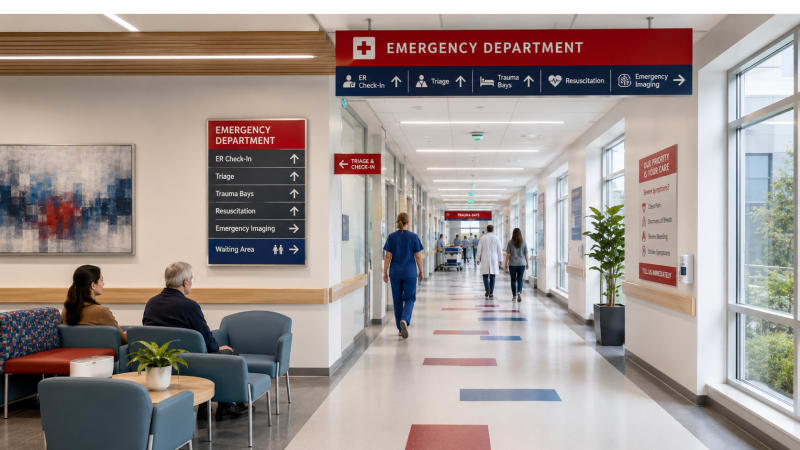
Emergency Department Operations: Running a High-Stakes Business Unit
The emergency department is unlike any other unit in a hospital. It never closes, it cannot turn patients away, and its patient mix is entirely unpredictable. For most health systems, the ED is simultaneously the front door of the hospital, a major cost center, and a critical revenue driver. Running it well is not just a clinical challenge — it is one of the most demanding operational and financial puzzles in all of healthcare.

The ED as a Business Unit
Most hospital administrators think of the emergency department primarily as a safety-net service. That framing is incomplete. The ED typically accounts for 40 to 60 percent of all hospital admissions, making it the single largest source of inpatient volume for most facilities. Every patient who walks through those doors is a potential admission, a follow-up appointment, a specialist referral, and a long-term relationship with the health system.
From a financial standpoint, ED economics are complex. Reimbursement is driven by acuity-based billing codes (CPT Level 1 through Level 5), with higher-acuity visits generating significantly more revenue. A Level 5 emergency visit can reimburse three to five times more than a Level 1. This means that documentation quality, coding accuracy, and physician billing practices have a direct and measurable impact on department revenue — often accounting for millions of dollars in variance annually across comparable facilities.
Payer mix is another critical variable. Emergency departments are legally required to screen and stabilize all patients regardless of ability to pay, under the Emergency Medical Treatment and Labor Act (EMTALA). This means the ED carries a disproportionate share of uncompensated care, Medicaid patients, and underinsured individuals compared to elective service lines. Managing this reality requires deliberate financial planning, not just clinical protocols.
Key Operational Levers
Three operational factors consistently separate high-performing EDs from struggling ones: throughput, staffing, and capacity management.
Throughput — measured by door-to-provider time, length of stay, and left-without-being-seen (LWBS) rates — is the heartbeat of ED efficiency. The national benchmark for door-to-provider time is under 30 minutes. Every minute beyond that increases the risk of patients leaving without care, which is both a safety issue and a direct revenue loss. A single percentage point improvement in LWBS rates can recover hundreds of thousands of dollars in annual revenue for a busy urban ED.
Staffing represents the ED's largest controllable cost. The rise of travel nurses and locum tenens physicians has given departments flexibility, but at a steep price premium — often 50 to 100 percent above permanent staff rates. Building a stable core team with selective use of supplemental labor is the most financially sustainable model. Workforce scheduling tools that align staffing levels with hourly and daily volume patterns can reduce overtime costs by 15 to 25 percent without sacrificing coverage.
Capacity management connects the ED to the rest of the hospital. Boarding — when admitted patients wait in ED beds for inpatient rooms — is one of the most damaging and costly phenomena in emergency medicine. It reduces throughput, increases diversion rates, worsens patient experience scores, and drives clinician burnout. Solving boarding is not an ED problem; it is a hospital-wide operational problem that requires executive-level commitment and system-wide bed management.
The Strategic View
For hospital executives and healthcare business consultants, the ED should be treated as a strategic asset — not just a regulatory obligation. Investments in fast-track units, observation units, behavioral health pathways, and physician triage at peak hours consistently yield positive ROI when properly implemented. Community outreach programs that redirect low-acuity patients to urgent care or primary care settings reduce unnecessary ED utilization while improving margins.
Understanding your ED's contribution margin, payer mix trends, and throughput benchmarks is the starting point for any meaningful improvement strategy.
Key Takeaway
The emergency department is a microcosm of everything challenging and consequential in healthcare operations. Managed strategically, it is a powerful engine for hospital volume, revenue, and community trust. Managed poorly, it becomes a financial drain and a reputational liability.
Ready to assess your ED's operational and financial performance? A structured business review of your emergency department can identify revenue leakage, staffing inefficiencies, and throughput bottlenecks — often uncovering seven-figure improvement opportunities within 90 days.
Written by
MD Zee
Comments
Log in to join the conversation.
Loading comments…