


Logo
AI in Healthcare Is Moving From Experiment to Everyday Support

AI in Healthcare Is Moving From Experiment to Everyday Support

LifestyleBy MedBary Team6/11/20265 min read

Artificial intelligence is rapidly becoming part of modern healthcare, supporting doctors with faster insights, smarter patient monitoring, and more efficient clinical workflows. But its real promise depends on responsible use, strong data protection, human oversight, and trust between patients and care teams.

Advertisement
Advertisement

AI in Healthcare Is Moving From Experiment to Everyday Support

Health Technology AI in Healthcare

AI in Healthcare Is Moving From Experiment to Everyday Support

Artificial intelligence is no longer just a futuristic idea in medicine. It is already helping healthcare teams read images, organize records, monitor patients, support research, and reduce administrative pressure — but its real value depends on safety, transparency, fairness, and human oversight [1][2].

The next phase of AI in healthcare will not be about replacing doctors. It will be about building tools that help clinicians make faster, safer, and more personalized decisions while protecting patient trust [3][4].

AI 1

Key Highlights

1,016

FDA authorizations of AI/ML-enabled medical devices were reviewed in a 2025 taxonomy study [2].

40+

recommendations appear in WHO guidance for large multi-modal AI models in health [3].

Clinical

AI is strongest when it supports doctors, nurses, pharmacists, and care teams rather than replacing them.

Trust

privacy, bias control, explainability, and accountability remain central to safe AI adoption [1][4].

Data

clean, representative, and secure health data is the foundation of useful healthcare AI.

Future

the biggest gains may come from workflow relief, earlier detection, and more personalized care.

Why AI in Healthcare Matters

Why It Matters

Healthcare is under pressure from rising demand, staff shortages, growing chronic disease burdens, and large volumes of medical data. AI matters because it can help convert that data into useful signals: a flagged scan, a risk alert, a summarized record, or a reminder that helps a patient stay on track.

The most promising applications are not dramatic science-fiction replacements for clinicians. They are practical tools that reduce friction: quicker image review, better triage, automated documentation, smarter scheduling, remote monitoring, and more personalized care pathways. The FDA says its AI-enabled medical device list is meant to improve transparency for providers and patients by identifying devices that use AI technologies [5].

The opportunity is real, but so is the risk. WHO guidance stresses that AI for health should be designed and deployed with ethics and human rights at the center, because tools that influence medical decisions can affect safety, access, privacy, and trust [1].

For patients, the real question is not whether AI sounds impressive. It is whether AI makes care safer, faster, clearer, and more equitable. For hospitals, the challenge is choosing tools that work in real clinical settings, not just in demonstrations.

AI 2

AI in healthcare is helping care teams improve diagnosis support, medical imaging, workflow, patient monitoring, and research while raising important questions about safety, transparency, fairness, and human oversight.

Detailed Viewpoint

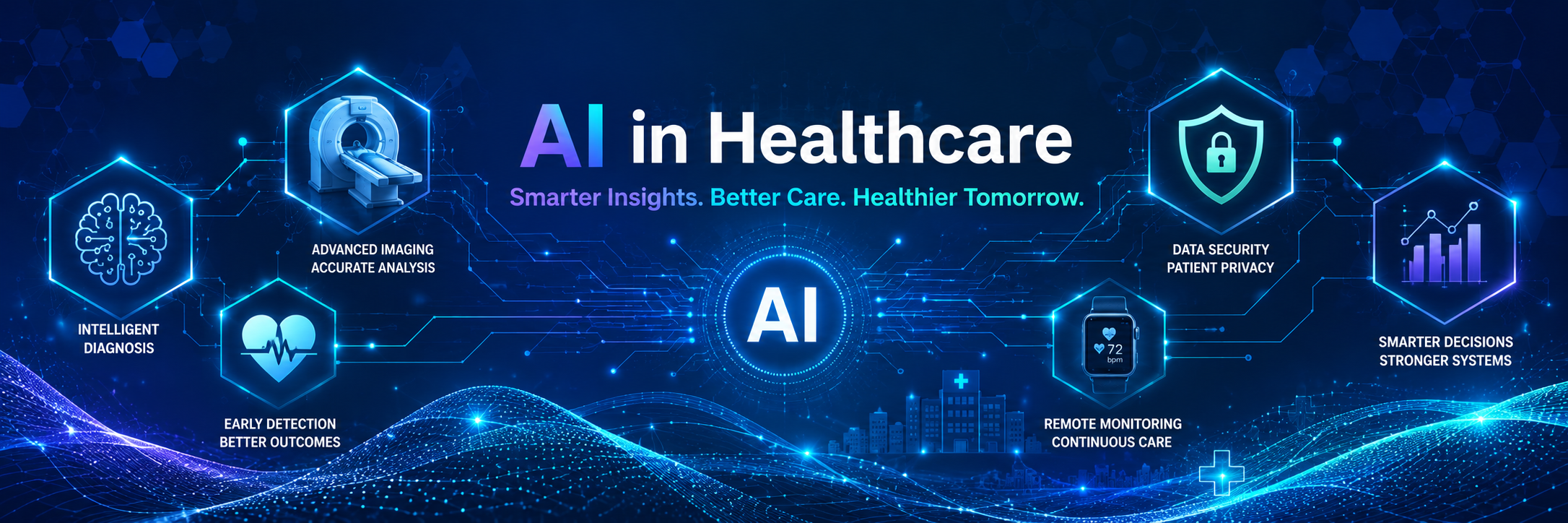
AI in healthcare works best when it acts like a second layer of attention. In medical imaging, algorithms can help detect patterns in X-rays, CT scans, MRIs, ultrasound, and retinal images. In clinical operations, AI can identify scheduling gaps, predict patient flow, and help teams manage limited resources. In research, it can scan large datasets to find signals that would take humans far longer to detect.

One reason imaging has become a major AI frontier is that images are structured enough for algorithms to analyze at scale. A 2025 Nature Digital Medicine study reviewed 1,016 FDA authorizations of AI/ML-enabled medical devices and found that quantitative image analysis remained the most common application, though the field is broadening over time [2].

Another fast-growing area is generative AI. Large multi-modal models can process different inputs, including text, images, and video, and generate outputs that may support documentation, patient communication, research review, and clinical workflow. WHO’s 2024 guidance on large multi-modal models includes over 40 recommendations for governments, technology companies, and healthcare providers [3].

Yet the most important point is balance. AI can be fast without being wise. It can detect patterns without understanding the full patient story. A model may perform well in one hospital but poorly in another if patient populations, equipment, or workflows are different. That is why healthcare AI needs validation, monitoring, accountability, and human judgment.

Clinical View

Doctors need AI that explains uncertainty, fits clinical workflows, and helps them make better decisions. A tool that creates more alerts without context can add noise instead of value.

Patient View

Patients need to know when AI is involved, what it is being used for, and who is responsible for the final decision. Transparency is part of trust.

There is also a governance challenge. AI tools may be trained on data that does not represent every community equally. If bias is not tested and corrected, the technology can widen health gaps instead of reducing them. WHO’s ethics guidance highlights challenges and risks and calls for AI to work for the public benefit across countries [1].

Healthcare leaders also have to ask practical questions before adopting AI. Who checks the model’s accuracy after deployment? How is patient data protected? What happens when the AI is wrong? Can clinicians override it? Does it improve outcomes, or only create a new layer of software?

The National Academy of Medicine’s 2025 AI Code of Conduct frames responsible AI as a trust-building effort that should apply from boardroom decisions to bedside care [4]. That framing is important: AI in healthcare is not just a technical upgrade. It is a clinical, ethical, operational, and human responsibility.

Diagnosis Support

AI can help surface patterns in scans, lab data, and patient records, but final interpretation should remain clinically accountable.

Workflow Relief

AI may reduce repetitive paperwork, organize records, and help clinical teams spend more time on patient care.

Patient Monitoring

Remote monitoring tools can flag changes earlier, especially for chronic conditions, post-surgery recovery, and high-risk patients.
AI 3

Citations & Credibility

  1. World Health Organization — “Ethics and governance of artificial intelligence for health”, WHO Guidance, 28 June 2021. https://www.who.int/publications/i/item/9789240029200
  2. Singh R. et al. — “How AI is used in FDA-authorized medical devices: a taxonomy across 1,016 authorizations”, npj Digital Medicine, 2025. https://www.nature.com/articles/s41746-025-01800-1
  3. World Health Organization — “WHO releases AI ethics and governance guidance for large multi-modal models”, WHO News Release, 18 January 2024. https://www.who.int/news/item/18-01-2024-who-releases-ai-ethics-and-governance-guidance-for-large-multi-modal-models
  4. National Academy of Medicine — “An Artificial Intelligence Code of Conduct for Health and Medicine: Essential Guidance for Aligned Action”, National Academies Press, 2025. https://www.nationalacademies.org/publications/29087
  5. U.S. Food and Drug Administration — “Artificial Intelligence-Enabled Medical Devices”, FDA. https://www.fda.gov/medical-devices/software-medical-device-samd/artificial-intelligence-enabled-medical-devices

Tags: Artificial Intelligence Healthcare Systems Clinical Workflow Digital Health Policy Medical Imaging AI Governance Patient Monitoring

Editorial Note: This article is produced for informational and educational purposes. It does not constitute medical advice. Patients should consult a qualified healthcare provider for diagnosis and treatment guidance. All statistics cited are sourced from peer-reviewed literature or named patient advocacy organizations as referenced above.

MedBary Team

Written by

MedBary Team

Comments

Log in to join the conversation.

Loading comments…

AI in Healthcare: Benefits, Risks & Everyday Use — Bloorian