
Logo
Can We Make Cells Young Again?

Can We Make Cells Young Again?

LifestyleBy MedBary Team6/12/20268 min read

A landmark clinical trial has treated its first human participant with a cellular reprogramming therapy — injecting genes that instruct aged cells to behave as if they were young. The target: glaucoma. The ambition: nothing less than reversing biological aging itself.

Advertisement
Advertisement

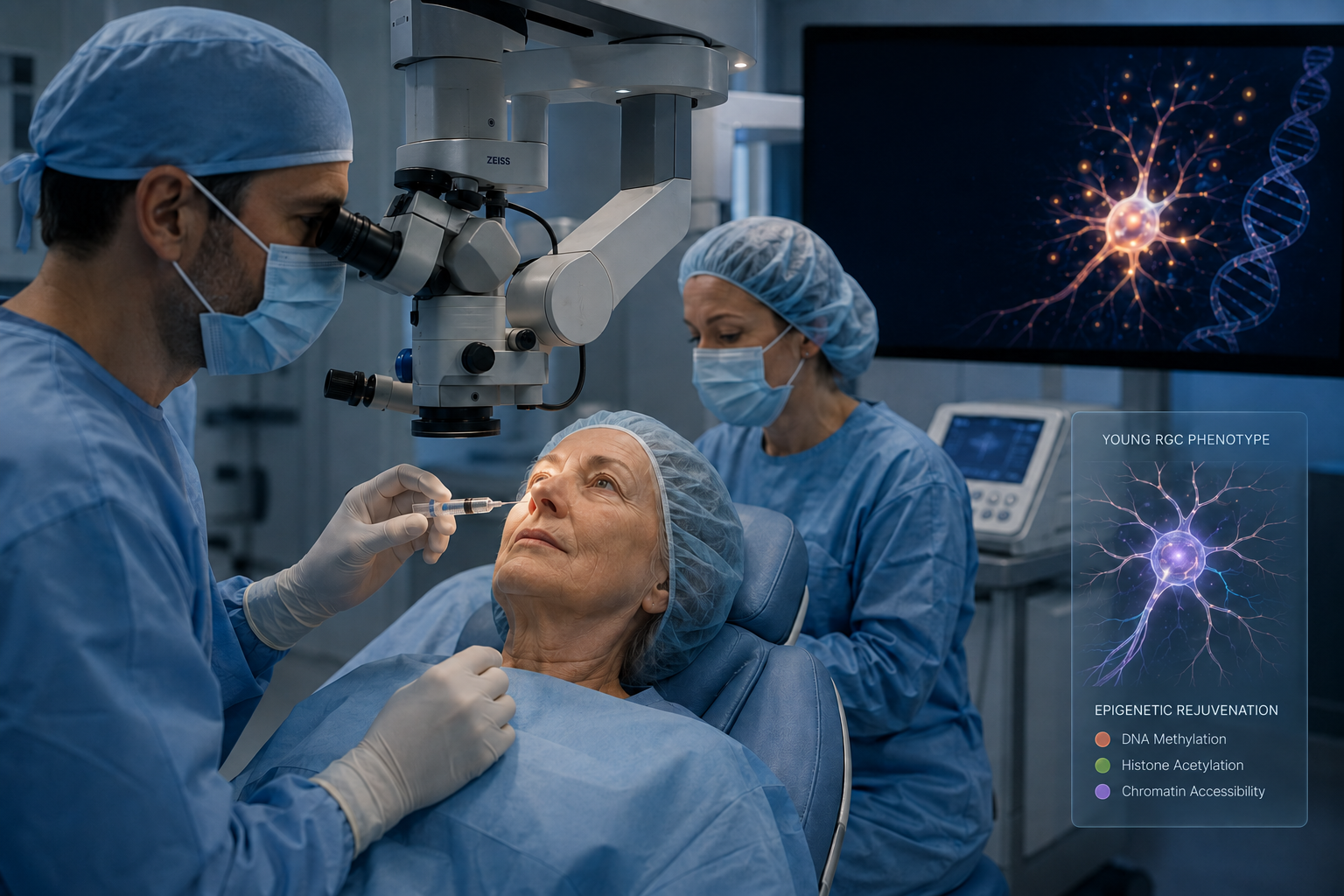
For the first time in medical history, a human patient has received a gene therapy designed not to fix a broken gene — but to instruct ageing cells to behave as though they were young again. The landmark clinical trial, sponsored by Boston-based Life Biosciences, targets glaucoma-damaged retinal neurons using a method called partial cellular reprogramming. If it works, it may redefine how science understands, and ultimately intervenes in, the ageing process itself.

Drawing on over a decade of laboratory research — from mouse retina regeneration to whole-body reprogramming experiments — this trial marks the transition of a bold scientific theory into human medicine. The stakes are enormous, and so are the unknowns.

846075eb ef0c 4850 8b8e 6e9588426360 1
Key Highlights

Five breakthroughs driving the age-reversal revolution

01
World-First Human Trial
Life Biosciences has treated its first patient with a partial reprogramming gene therapy — a global first in the effort to reverse ageing at the cellular level, targeting optic nerve neurons damaged by glaucoma.
02
The Yamanaka Factor Framework
Three of the four Nobel-winning Yamanaka reprogramming factors (OCT4, SOX2, KLF4 — with c-Myc removed for safety) form the backbone of the therapy, delivered via viral vector directly into the eye.
03
Epigenetic Clock as the Target
Harvard's Sinclair Lab proposed that ageing is essentially the progressive corruption of the epigenome — chemical "noise" layered atop DNA. Partial reprogramming aims to clear this noise and restore youthful gene expression patterns.
04
Mouse Studies Show Proof of Concept
Preclinical work demonstrated restored vision after optic nerve injury, extended lifespan in progeria models, improved muscle and cardiac regeneration, and enhanced cognitive function — all through partial reprogramming alone.
05
The Eye as the Ideal Test Bed
The eye's immune privilege, containment, and accessibility make it the lowest-risk site to test a technology with significant unknown side effects — including the possibility of triggering cancerous cellular states.
Why It Matters

Ageing is no longer treated as inevitable — it's being engineered against

The significance of this trial is hard to overstate. Ageing touches every organ system in the body and underpins the majority of the world's most debilitating diseases — from Alzheimer's and Parkinson's to cardiovascular disease, type 2 diabetes, and cancer. Most medical interventions address these conditions individually, treating downstream symptoms while the upstream process — cellular ageing — continues unchecked.

Partial reprogramming represents a fundamentally different approach: instead of treating a disease, it aims to restore the cellular machinery that prevents disease from arising in the first place. If it proves safe in the eye, it opens a rational path toward testing the same strategy in the brain, heart, kidneys, and beyond.

76M+
people globally affected by glaucoma, the trial's initial target condition
$3B+
in private investment poured into longevity and cellular reprogramming research since 2020
2006
year Yamanaka's Nobel-winning discovery of cellular reprogramming factors was published

"Reprogramming has a big upside if it can be used safely in people. The technology is still really early, and the potential for catastrophic side effects is high."

— Matt Kaeberlein, Co-founder, Optispan · Longevity Medicine Researcher
4a682d3f 1afb 4bc3 9f36 7651fedac1ad 2
Detailed Viewpoint

From Nobel Prize to Clinical Trial: The Science Behind Cellular Rejuvenation

The Discovery That Changed Everything

In 2006, stem-cell biologist Shinya Yamanaka and his colleagues achieved something that most of the scientific world considered impossible: they transformed ordinary adult skin cells back into a state resembling embryonic stem cells. By introducing just four proteins — now known as the Yamanaka factors (OCT4, SOX2, KLF4, and c-Myc) — they demonstrated that a cell's developmental fate is not fixed. The finding earned Yamanaka the Nobel Prize in Physiology or Medicine in 2012 and launched an entire field.

But complete reprogramming is clinically dangerous: a fully reverted cell loses its specialised identity and risks becoming tumourous. The real longevity opportunity lay in going only partway — briefly applying the reprogramming signal, then withdrawing it before the cell forgets what it is.

Ageing as Information Corruption

Harvard geneticist David Sinclair and colleagues at the Blavatnik Institute have developed the "Information Theory of Ageing." In this framework, DNA is a complete and stable blueprint. Ageing is not the corruption of that blueprint but rather the degradation of the epigenome — the layered system of chemical marks that determines which genes are read in which cells. Over decades, these marks accumulate errors Sinclair calls "epigenetic noise," and cells gradually lose the ability to express the right genes at the right times.

To test this, Sinclair's lab created the "ICE" mouse — a model in which DNA breaks could be induced on demand, rapidly producing epigenetic ageing without altering the underlying DNA sequence. This confirmed that epigenetic disruption alone is sufficient to drive the ageing phenotype.

The Analogy

If DNA is the digital data on a compact disc, then ageing is the scratches on the disc's surface. Partial reprogramming is the polish that restores read-access — without erasing the underlying data. — Sinclair Lab, Harvard Medical School

The Road From Mouse Retinas to Human Eyes

The direct precursor to the current human trial was work by Yuancheng Ryan Lu — then at the Sinclair Lab, now at the Whitehead Institute — who introduced three Yamanaka factors (excluding c-Myc) into the eyes of ageing mice. The treated animals showed measurable regeneration of retinal ganglion cells and restoration of visual function.

The 2016 Izpisúa Belmonte study at the Salk Institute extended these findings — cyclic expression of Yamanaka factors prolonged lifespan in progeria mouse models and improved regeneration of muscle and pancreatic tissue in normal ageing mice.

Key Milestones
2006
Yamanaka publishes discovery of four reprogramming factors; iPS cells created from adult cells.
2016
Izpisúa Belmonte team demonstrates cyclic reprogramming extends lifespan and improves tissue regeneration in mice.
2020
Sinclair Lab restores vision in aged mice via three-factor OSK reprogramming — direct basis for the human trial.
2023–2024
Multiple labs confirm whole-body reprogramming safety in mice; FDA IND applications filed; private investment exceeds $3 billion.
June 2026
Life Biosciences treats first human participant in Phase I partial reprogramming trial. History begins here.

Risks, Unknowns, and the Cancer Question

The most pressing concern is tumourigenesis. A cell pushed too far toward a stem-like state loses its regulatory brakes — the mechanisms that prevent uncontrolled proliferation. This is precisely why c-Myc, a well-documented oncogene, was removed from the therapeutic combination. The remaining three factors (OSK) have a markedly safer preclinical profile, but their long-term fate in human tissue remains unanswered.

Some researchers advocate for mRNA delivery (which degrades quickly) rather than viral vectors (which can persist), or gene circuits that shut themselves off after a defined period. Tamir Chandra at the Mayo Clinic has noted that when cells lose their identity, known dangers follow.

Despite these concerns, the eye's immune privilege and physical containment make it the most forgiving first environment. Any adverse event stays local and observable rather than cascading systemically — which is why the longevity research community broadly regards the eye as the rational first step.

21c39683 a85b 4058 8543 9ab29a963ef1 3
Citation & Credibility

Sources, Research Institutions & Verification

Primary News Source
Life Biosciences Clinical Trial Announcement
Reported June 9, 2026. Life Biosciences (Boston, MA) confirmed the treatment of the first human participant in a partial cellular reprogramming trial targeting retinal ganglion cells via viral gene delivery.
Peer-Reviewed Research
Lu Y. et al., Nature (2020)
Demonstrated partial OSK-factor reprogramming restores visual function in aged mice with optic nerve injury. Yuancheng Ryan Lu, now at Whitehead Institute (MIT). Foundational study for the current human trial.
Academic Institution
Sinclair Lab, Harvard Medical School
Blavatnik Institute, Dept. of Genetics. Developed the Information Theory of Ageing, the ICE mouse model, and human-compatible viral vectors for reprogramming gene delivery.
Supporting Research
Izpisúa Belmonte et al., Salk Institute (2016)
Cyclic expression of Yamanaka factors extended lifespan in progeria mouse models and improved muscle and pancreatic tissue regeneration — a pivotal early validation of partial reprogramming.
Expert Commentary
Kaeberlein, M. — Optispan; Chandra, T. — Mayo Clinic
Independent expert commentary on safety, biological risk, and timeline realism. Both are unaffiliated with Life Biosciences and have active ageing-biology research programmes.
NIH / Clinical Registry
PMC Review — Partial Reprogramming Mechanisms (2025)
PubMed Central peer-reviewed review (PMC12096755) covering mechanistic analysis of OSK partial reprogramming, epigenetic rejuvenation pathways, and safety profile evaluation across preclinical studies.
Editorial Credibility Note

All scientific claims are drawn from peer-reviewed publications, active institutional research programmes (Harvard Medical School, Whitehead Institute, Salk Institute, Mayo Clinic), and verified announcements from the sponsoring company. No claims have been extrapolated beyond what is supported by cited preclinical or clinical evidence. This field remains in early-stage human trials; readers are encouraged to follow peer-reviewed literature for evolving outcomes.

Article Tags
Cellular Reprogramming Longevity Science Epigenetics Gene Therapy Glaucoma Research Clinical Trials Yamanaka Factors Harvard Medical School Ageing Biology Life Biosciences
Editorial Note

A Note on Scientific Progress and Expectation

This article covers an active area of early-stage clinical research. The first human trial of partial cellular reprogramming is a Phase I safety study — its primary objective is to establish that the therapy does not cause serious harm. Results that speak to efficacy will take months to years to emerge and will require rigorous peer review before they can be interpreted with confidence.

The broader application of partial reprogramming to systemic ageing in humans remains speculative at this stage. Readers are encouraged to interpret this development as a significant scientific milestone, not a clinical breakthrough — a distinction that matters greatly in translational medicine.

Content compiled from peer-reviewed publications, institutional research pages, and verified public announcements. All scientific claims are referenced to primary sources. Bloorian does not represent or endorse any specific clinical outcome or investment position.

MedBary Team

Written by

MedBary Team

Comments

Log in to join the conversation.

Loading comments…

Can We Make Cells Young Again? — Bloorian