


You're Not Diabetic Yet — And That's Everything
Somewhere between normal and diabetic lives a window — and it's still open.

More than 98 million adults in the United States are living with prediabetes — and the vast majority don't know it. Yet this silent metabolic warning carries one of the most powerful pieces of good news in preventive medicine: with the right dietary shifts and lifestyle habits, type 2 diabetes can be delayed or avoided entirely. This article unpacks the science, the food strategies, and the clinical consensus that make diet the single most accessible lever for reversing prediabetes.

Prediabetes occupies a medically critical space — blood sugar is elevated (fasting glucose between 100–125 mg/dL, or an A1C of 5.7%–6.4%), but the body hasn't yet crossed into full type 2 diabetes territory. This zone is not a mild inconvenience. Left unaddressed, approximately 37% of people with prediabetes will develop type 2 diabetes within four years, according to Yale Medicine.
The economic and human cost is staggering. Type 2 diabetes is the leading cause of kidney failure, adult-onset blindness, and non-traumatic lower limb amputation in the United States. It significantly elevates risk for cardiovascular disease, stroke, and nerve damage. Yet because prediabetes often produces no noticeable symptoms, millions navigate daily life unaware their metabolic health is deteriorating.
What makes prediabetes different from most chronic conditions is its reversibility. Diet is not merely supportive — it is primary medicine. A sustained dietary shift can bring blood glucose back into normal range, reduce cardiovascular risk, improve insulin sensitivity, and in many cases, eliminate the prediabetes diagnosis entirely.
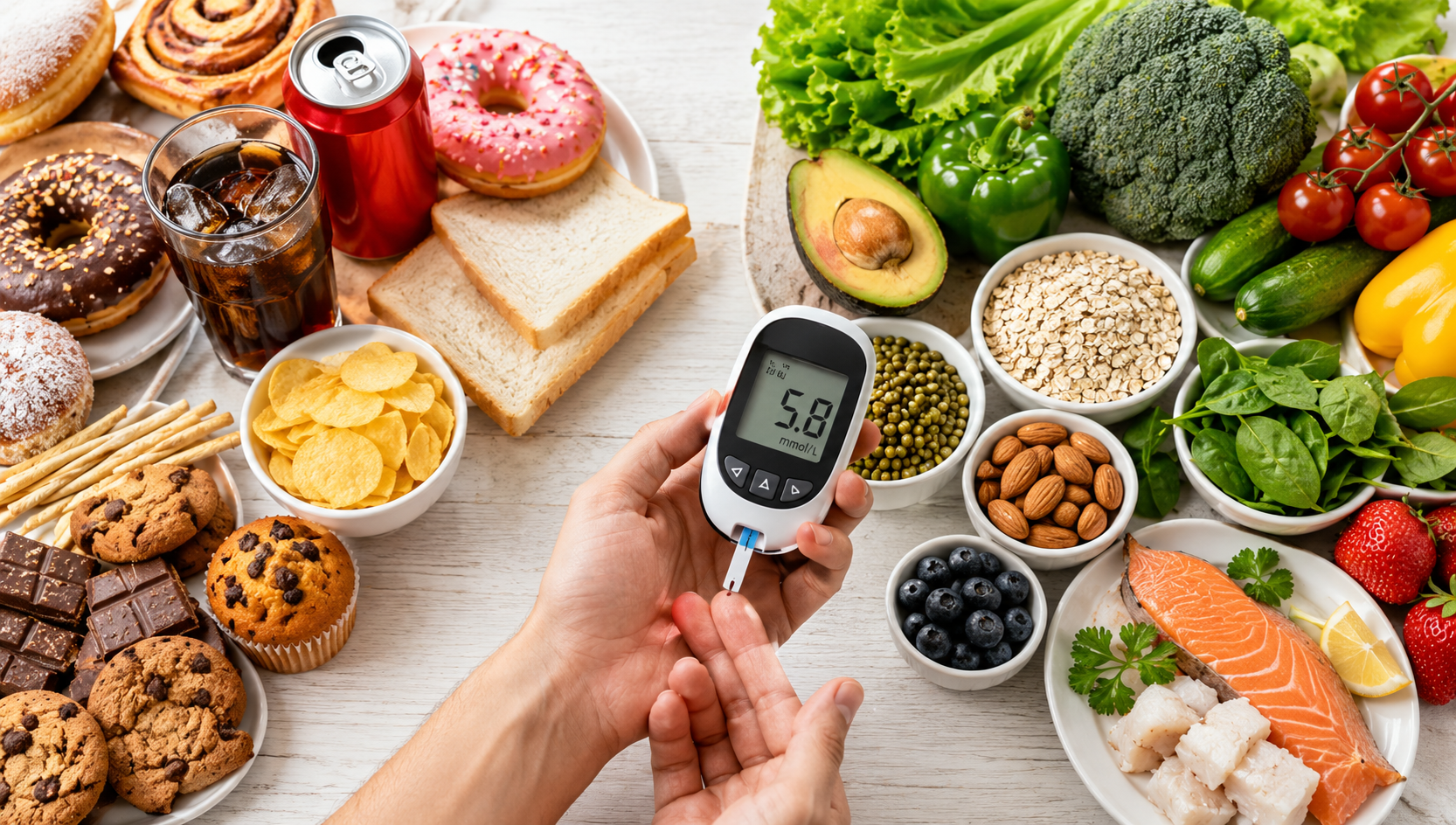
Prediabetes is defined by the American Diabetes Association as a fasting blood glucose level of 100–125 mg/dL, a two-hour glucose tolerance test result of 140–199 mg/dL, or an A1C between 5.7% and 6.4%. These thresholds indicate that the body's cells have become partially resistant to insulin — the hormone that escorts glucose from the bloodstream into cells for energy. The pancreas compensates by producing more insulin, but this compensatory mechanism eventually begins to fail without intervention.
Crucially, prediabetes is not a fixed state. Research published in Nutrients (PMC7650618) confirms that dietary patterns directly influence insulin sensitivity and can shift glucose levels back into the normal range — particularly when intervention begins early.
Johns Hopkins dietitian and diabetes educator Tara Seymour describes the plate method — endorsed by the American Diabetes Association — as a practical, non-restrictive framework. The proportions are straightforward: half the plate filled with non-starchy vegetables (leafy greens, broccoli, cucumbers, bell peppers), a quarter with high-quality complex carbohydrates (brown rice, farro, quinoa, legumes), and the remaining quarter with lean protein such as fish, chicken, turkey, or tofu.
Among structured dietary patterns, the Mediterranean diet stands out in the clinical literature for prediabetes management. It emphasizes olive oil over saturated fats, abundant fresh vegetables and fruits, legumes, whole grains, nuts, fish, and moderate dairy — while limiting red meat and processed foods. A 2020 systematic review in Nutrients found that adherence to Mediterranean dietary principles consistently improved fasting glucose and A1C levels in individuals with insulin resistance and prediabetes.
The pattern works through multiple mechanisms: its high fiber content slows glucose absorption, its unsaturated fats improve cell membrane responsiveness to insulin, and its antioxidant load reduces the chronic low-grade inflammation that drives insulin resistance. Importantly, it doesn't eliminate any food group — making it sustainable long-term.
For people with prediabetes, sugar management is not just about desserts — it's about decoding everyday products. The World Health Organization advises capping added sugar at 10% of total caloric intake (roughly 50g for a 2,000-calorie diet), with additional benefits seen below 5% (≈25g). The American Heart Association is stricter still: under 25g/day for women and under 36g/day for men at cardiovascular risk.
| Beverage / Food | Sugar (g) | AHA Limit Used |
|---|---|---|
| Can of regular soda (355ml) | ~32g | 128% (women) |
| Large flavoured coffee drink | ~40–55g | 160–220% (women) |
| Fruit juice (250ml glass) | ~22–26g | 88–104% |
| Whole fresh apple | ~19g (natural) | Fibre-bound; low glycaemic impact |
Source: Hopkins Medicine / AHA guidelines. Natural sugars in whole fruit behave differently from added sugars due to fibre content.
Dietary fiber is arguably the single most protective nutrient for prediabetes. Hopkins dietitians recommend a target of 25–30g of fiber daily, achievable through a mix of vegetables, fruits, legumes, oats, and whole grains. Soluble fiber — found in oats, lentils, apples, and barley — directly slows the absorption of glucose into the bloodstream, blunting post-meal blood sugar spikes.
On the "limit" side, refined carbohydrates (white bread, white pasta, white rice) deserve consistent moderation — not elimination. These foods digest quickly, driving rapid glucose spikes. Saturated and trans fats, common in processed snacks, fried foods, and full-fat dairy, further impair insulin signalling. Grapefruit and pomegranate juice, while nutritious, can interfere with the metabolism of certain medications via the cytochrome P450 enzyme system and should be discussed with a physician if medications are involved.
Diet works most powerfully alongside physical movement. The landmark NIH Diabetes Prevention Program Outcomes Study — one of the most influential trials in metabolic medicine — demonstrated that participants who combined dietary change with at least 150 minutes of moderate weekly activity and achieved 5–7% body weight reduction cut their risk of progressing to type 2 diabetes by up to 58%.
Johns Hopkins research specifically found that lifestyle changes resulting in modest weight loss delayed type 2 diabetes onset by 34% over four years compared to placebo — a meaningful and clinically significant outcome. Muscle contraction during exercise acts as an insulin-independent pathway for glucose uptake, providing direct metabolic benefit even before weight loss becomes significant.


Written by
MedBary Team
Comments
Log in to join the conversation.
Loading comments…