


How Generative AI Is Reshaping Content Creation in 2026 and 2027
Generative AI in 2026 has transformed content creation into a fast, scalable, and highly personalized process, enabling industries to produce multimodal media at unprecedented speed and efficiency. Human creativity, however, remains essential for cultural insight, originality, and ethical direction as AI reshapes the future of media and storytelling.

By 2026, the question is no longer whether generative AI has changed content creation. It has, irrevocably and at scale. The question now is how deeply the transformation reaches, who controls the tools, and what role human creativity plays in a media landscape where AI can draft, design, compose, and publish faster than any individual creator. As we move through 2026 and into 2027, the industry is grappling with a second wave of change that is more structural, more commercial, and more contested than the first.
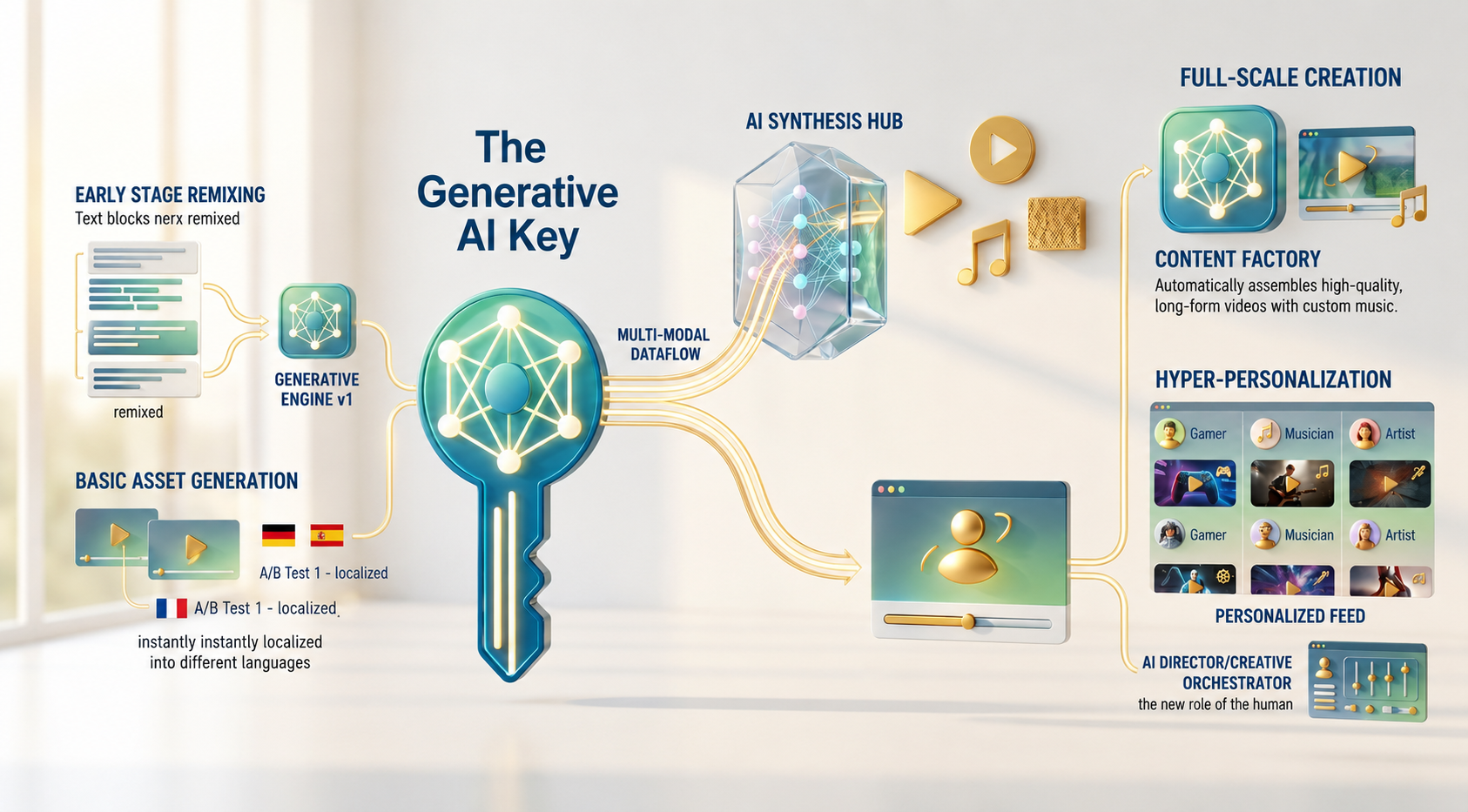
The first wave, between 2023 and 2025, was about adoption and astonishment. Newsrooms, marketing agencies, film studios, and music labels experimented with generative tools, testing what AI could do, where it failed, and how much cost it could eliminate. By early 2026, that phase of experimentation is largely over. What replaced it is integration at an industrial scale. Major publishing groups in Europe and North America report that AI now contributes to more than 70 percent of first-draft content across their digital properties. Advertising agencies have restructured their creative departments, with AI handling high-volume campaign variants while human strategists focus on brand direction and cultural relevance.
The tools themselves have matured significantly. The generative AI platforms of 2026 are multimodal - seamlessly combining text, image, video, audio, and interactive elements in response to a single creative brief. A marketing team can now input a campaign concept and receive, within minutes, a full suite of assets calibrated for different platforms, audiences, and cultural contexts. The iteration speed has changed creative processes fundamentally: teams that once spent three weeks developing a campaign now run hundreds of variants in a day, using performance data to select and refine in near real time.
In journalism, the changes are reshaping editorial economics in ways that are both promising and alarming. AI-generated reporting on financial results, sports statistics, local government decisions, and weather events has expanded the volume of coverage that news organisations can produce without proportional increases in headcount. The Associated Press, Reuters, and regional news groups are using AI to cover stories that would previously have gone unreported due to resource constraints. But investigative journalism, cultural criticism, and the kind of nuanced long-form reporting that requires human judgment, relationship-building, and on-the-ground presence has not been automated and the concern is that the commercial savings from AI in commodity content will not be reinvested in the harder and more expensive forms of journalism that democratic societies most need.
The film and television industry in 2026 is navigating the aftermath of significant labour negotiations that followed the 2023 writers' and actors' strikes. The agreements reached then which established frameworks for AI use, residual rights when AI is trained on human performances, and minimum human creative involvement thresholds in productions are being tested and renegotiated as the technology outpaces the frameworks. AI-generated visual effects, synthetic voice performances, and AI-assisted scriptwriting are now standard tools in production; the debates centre on attribution, compensation, and the minimum creative contribution required to maintain a production's eligibility for human creative credits and awards consideration.
Looking specifically at 2027, the emerging frontier is autonomous content agents - AI systems that do not merely respond to human prompts but proactively identify content opportunities, generate content, publish it across platforms, and optimise it based on audience response, all with minimal human involvement. Several digital media companies are testing these systems for specific content categories. The economic logic is compelling: a content agent that monitors trending topics, generates relevant articles optimised for search and social engagement, and publishes them in minutes requires a fraction of the cost of a human editorial team producing equivalent volume. The journalistic and cultural implications are being debated with growing urgency.
The legal landscape is shifting under the pressure of court decisions expected in 2026 and 2027 that will determine the intellectual property rights framework for AI-generated content. Cases in the United States and European Union are advancing through courts that will rule on whether AI training on copyrighted material constitutes infringement, what rights (if any) AI-generated content can claim, and what disclosure obligations exist when content is substantially AI-generated. The outcomes will have profound commercial and creative consequences for every company and creator operating in the digital content economy.
The human creators who are thriving in 2026 are those who have learned to use AI as a production partner while maintaining the cultural insight, emotional intelligence, and original perspective that AI tools cannot generate from statistical patterns alone. The ones struggling are those in roles that AI has made economically redundant, translators, certain categories of copywriters, stock illustrators without the skills or support to transition. The reshaping of content creation by generative AI is, in the end, also a reshaping of who creates, who is compensated, and what the word 'creative' means in an economy where machines can produce at a scale and speed no human can match.
Written by
Amit Kumar
Comments
Log in to join the conversation.
Loading comments…