


Is Full-Fat Dairy Good for Blood Sugar?
LifestyleBy MedBary Team6/24/20267 min read
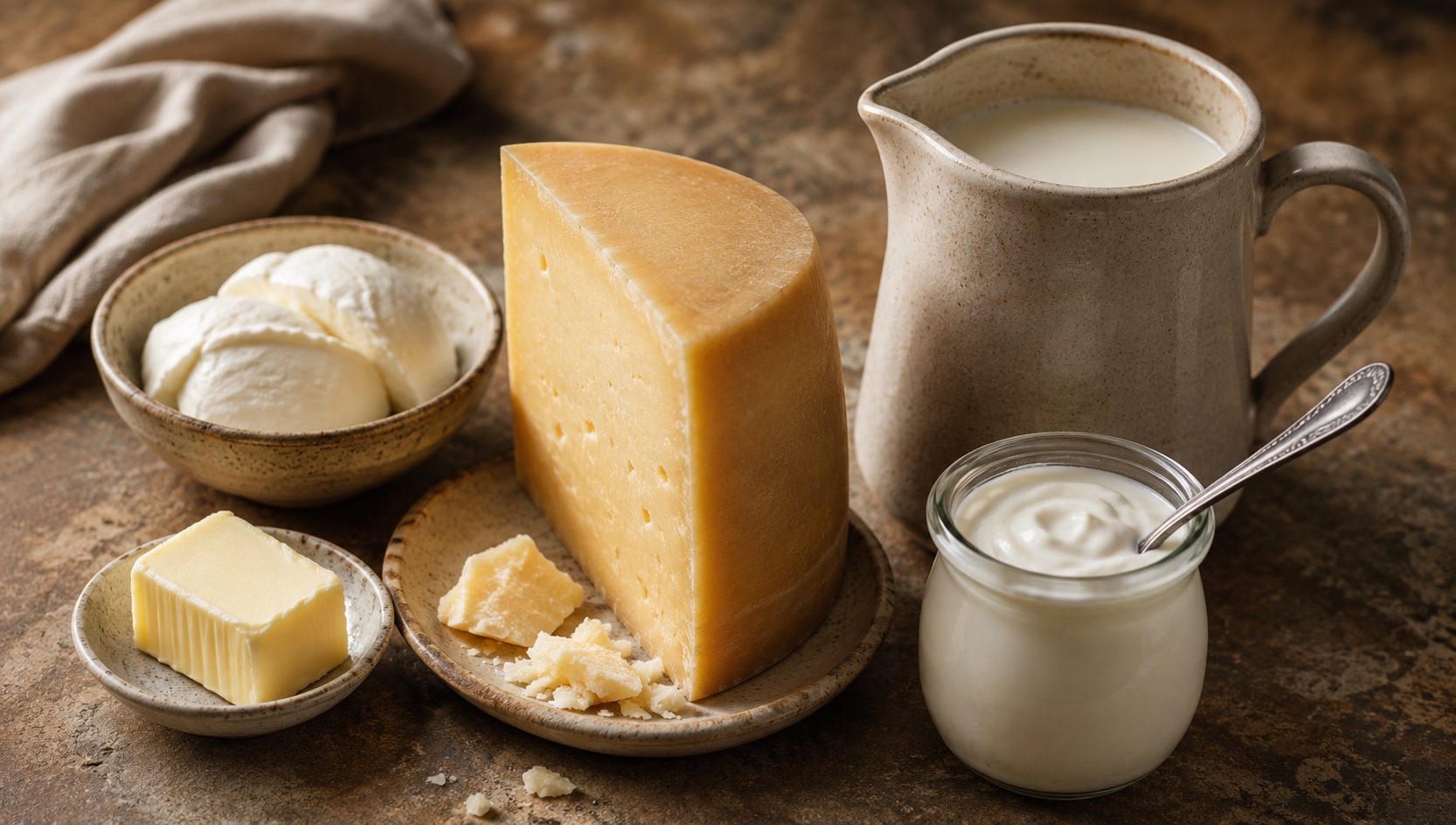
Whole milk, cheese, and full-fat yoghurt were once foods people were told to avoid. New research suggests they may not affect blood sugar and metabolic health the way we once thought.
Advertisement
Key Highlights
45%
Lower diabetes risk among those with the highest dairy fat biomarkers over 15 years
23%
Reduction in type 2 diabetes risk for highest full-fat dairy consumers, per Lund University
24%
Lower coronary artery calcification risk in whole-fat dairy consumers over 25 years
147K+
Individuals across 21 countries in the landmark PURE study on dairy and metabolic syndrome
Bottom line: Multiple independent studies across different populations and methodologies consistently find that whole-fat dairy — not low-fat — is associated with reduced metabolic risk. Low-fat dairy shows little to no protective signal in the same datasets.
Why It Matters
Type 2 diabetes affects more than 500 million people globally and the numbers are still climbing. For years, dietary guidance centred on reducing saturated fat intake — a recommendation that pushed millions toward low-fat dairy alternatives. That guidance was built on a logical-seeming premise: fat raises cholesterol, cholesterol harms hearts, therefore cut fat. But the relationship between food and metabolic health rarely works in straight lines.
What these newer studies reveal is that the matrix of a food — how its nutrients are packaged together — changes how the body responds. Dairy fat does not travel alone. It arrives alongside protein, calcium, magnesium, potassium, vitamin K2, and a suite of bioactive fatty acids like conjugated linoleic acid (CLA) and odd-chain saturated fats such as pentadecanoic acid (C15:0) and heptadecanoic acid (C17:0). Those odd-chain fats have become biological markers of dairy fat exposure in the bloodstream and appear to be the strongest predictors of lower diabetes risk in observational data.
There is also the question of what happens when full-fat dairy is replaced. Low-fat dairy products often carry higher sugar loads and refined carbohydrate content to compensate for lost flavour. Swapping fat for fast-digesting carbs is not a metabolically neutral trade — it can raise insulin demand more sharply than the fat it replaced.
"The overall effects of a food are not equivalent to those of the individual nutrients it contains. In the case of whole-fat dairy, the drawback of higher blood cholesterol caused by saturated fat may be outweighed by the benefits of the unique blend of nutrients and other constituents also found in dairy." — Ethan Cannon, University of Minnesota School of Public Health, 2025

Detailed Viewpoint
The pivot in this conversation was partly sparked by a long-running American study that tracked blood levels of dairy fat biomarkers — specifically odd-chain fatty acids — in roughly 3,000 participants over 15 years. Those in the highest tier of dairy fat biomarkers had about 45 percent lower odds of developing diabetes than those in the lowest tier. This was not a question of self-reported food diaries, which can be unreliable. It was a measure of what was actually circulating in participants' blood, making it a more objective window into what they had been eating over time.
A Lund University research team in Sweden took a complementary approach, examining dietary habits and diabetes outcomes in a Swedish cohort. Their conclusion: people who ate the most high-fat dairy products — specifically full-fat yoghurt and cheese — had a 23 percent lower risk of developing type 2 diabetes compared to those who ate the least. The key distinction was fat content: low-fat dairy versions showed no comparable protective effect in the same data. The findings were published in the American Journal of Clinical Nutrition.
| Study / Source | Population | Key Finding |
|---|---|---|
| Biomarker cohort (AJCN, 2025) | ~3,000 / 15 years | ~45% lower diabetes risk in top dairy-fat biomarker quartile |
| Lund University (AJCN) | Swedish cohort | 23% lower T2D risk, highest full-fat dairy consumers |
| PURE Study (BMJ, 2020) | 147,812 / 21 countries | Whole-fat dairy linked to lower MetS, hypertension & diabetes; low-fat showed no significant effect |
| UMN / CARDIA (J. Nutrition, 2025) | 3,100+ / 25 years | 24% lower coronary artery calcification in highest whole-fat dairy consumers |
| Metabolism Journal (2014) | Controlled analysis | C15:0 and C17:0 fatty acids inversely associated with insulin resistance markers |
The PURE study may be the most expansive piece of this puzzle. Spanning 147,812 people across 21 countries and five continents — with a median follow-up of over nine years — it found that whole-fat dairy, but not low-fat dairy, was associated with a lower prevalence of metabolic syndrome and a lower incidence of both hypertension and diabetes. Low-fat dairy consumed alone showed no significant protective effect in the same dataset.
On the cardiovascular side, the University of Minnesota's CARDIA cohort tracked young adults over 25 years and measured coronary artery calcification — calcium deposits in the arteries that signal early-stage heart disease. Those who regularly consumed the most whole-fat dairy in young adulthood were 24 percent less likely to show signs of this calcification decades later. Low-fat dairy showed no such relationship. Researchers noted that BMI played a partial role, but the protective association held even after adjustment.
Where does this leave the saturated fat debate? It complicates it, without dismantling it. Whole-fat dairy does raise LDL cholesterol to some degree. But the emerging consensus among nutrition researchers is that this effect appears to be partially or fully offset by other components — the bioactive fatty acids, the protein quality, the mineral density, and possibly the probiotic content of fermented dairy like yoghurt and aged cheese.
What remains genuinely unclear is the mechanism. Researchers at McGill University's dairy and diabetes programme and others are still working to pinpoint which specific compounds drive the metabolic benefits — whether it is the odd-chain fatty acids acting on cellular insulin signalling, the vitamin K2 moderating arterial calcification, or the fermentation byproducts in yoghurt and cheese doing something distinct from liquid milk. Until randomised controlled trials test these pathways directly at scale, the picture relies on observational data, which can show association but not confirm cause.
Important nuance: None of these studies suggest unlimited consumption or a dismissal of overall diet quality. The signal from the data is that within a balanced dietary pattern, choosing whole-fat dairy over its low-fat counterpart does not appear to carry the metabolic penalty once assumed — and may carry a measurable benefit.

Citations & Credibility
This article draws exclusively on peer-reviewed research, university studies, and data from established academic journals. No industry funding or dairy board sources were used. All studies cited are published in indexed scientific journals or released by accredited research universities.
1. American Journal of Clinical Nutrition (2025)
Biomarker-based study (~3,000 participants, 15-year follow-up) on dairy fat blood markers and diabetes incidence. doi.org/10.1016/S0002-9165(25)00136-4
2. Lund University / American Journal of Clinical Nutrition
Swedish cohort study linking high-fat dairy consumption (yoghurt, cheese) to 23% lower type 2 diabetes risk. lunduniversity.lu.se
3. PURE Study — BMJ Open Diabetes Research & Care (2020)
Multinational prospective study of 147,812 individuals across 21 countries examining dairy intake, metabolic syndrome, hypertension, and diabetes. doi.org/10.1136/bmjdrc-2019-000826
4. University of Minnesota School of Public Health / The Journal of Nutrition (2025)
CARDIA cohort study (3,100+ participants, 25-year follow-up) examining whole-fat dairy and coronary artery calcification risk. sph.umn.edu
5. Metabolism Journal (2014)
Controlled analysis of odd-chain saturated fatty acids (C15:0, C17:0) as dairy fat biomarkers and their inverse relationship with insulin resistance. doi.org/10.1016/j.metabol.2014.01.007
6. McGill University — Dairy & Diabetes Research Programme
Ongoing research into the biological mechanisms linking dairy consumption to diabetes risk. mcgill.ca/dairy-diabetes
All statistics are drawn directly from published study abstracts or institutional press releases. Observational studies show association, not causation — dietary research is inherently complex and findings should be interpreted within the broader context of overall diet quality.
Tags
Full-Fat Dairy
Type 2 Diabetes
Blood Sugar
Metabolic Health
Nutrition Science
Heart Health
Dairy Research
Saturated Fat
Dietary Fat
Food Matrix
Editorial Note
This article is intended for informational and educational purposes. It reflects findings from peer-reviewed academic research and does not constitute medical or dietary advice. Readers managing diabetes, cardiovascular conditions, or any metabolic health concern should consult a qualified healthcare professional before making dietary changes.
The studies referenced are predominantly observational in design. While they draw on large populations and long follow-up periods, observational research cannot establish direct causation. Randomised controlled trials at scale are needed to confirm the mechanisms proposed.

Written by
MedBary Team
Comments
Log in to join the conversation.
Loading comments…