



Medical Tourism Industry Overview: A $100 Billion Global Business
The World Is Your Hospital

Every year, millions of people board international flights not for vacation, but for surgery, dental work, fertility treatments, cancer care, and wellness programs. Medical tourism — the practice of travelling across borders to receive healthcare — has grown from a niche phenomenon into one of the fastest-expanding sectors in the global economy. For business consultants, hospital executives, and healthcare investors, understanding this industry is no longer optional. It is a strategic imperative.
The Scale of the Opportunity
The global medical tourism market is valued at well over $100 billion and is projected to grow at a compound annual rate of 12 percent or more through the end of this decade. That growth is being driven by a convergence of powerful forces: rising healthcare costs in wealthy nations, dramatic improvements in clinical quality at international facilities, the expansion of accreditation standards that give patients confidence in overseas providers, and the digital revolution that makes researching and booking care abroad as simple as booking a flight.
The United States, Canada, the United Kingdom, and Australia are among the largest source markets — countries where patients face long wait times, high out-of-pocket costs, or simply lack access to certain procedures. Destination markets, including Thailand, India, Mexico, Turkey, Singapore, and Malaysia, have invested heavily in world-class hospital infrastructure, English-speaking medical staff, and international patient departments designed to serve a global clientele.
An estimated 14 to 20 million medical tourists cross borders for care each year. That number is expected to rise sharply as aging populations in high-income countries face growing healthcare needs, and as global connectivity makes the logistics of international medical travel increasingly seamless.
What Patients Are Seeking
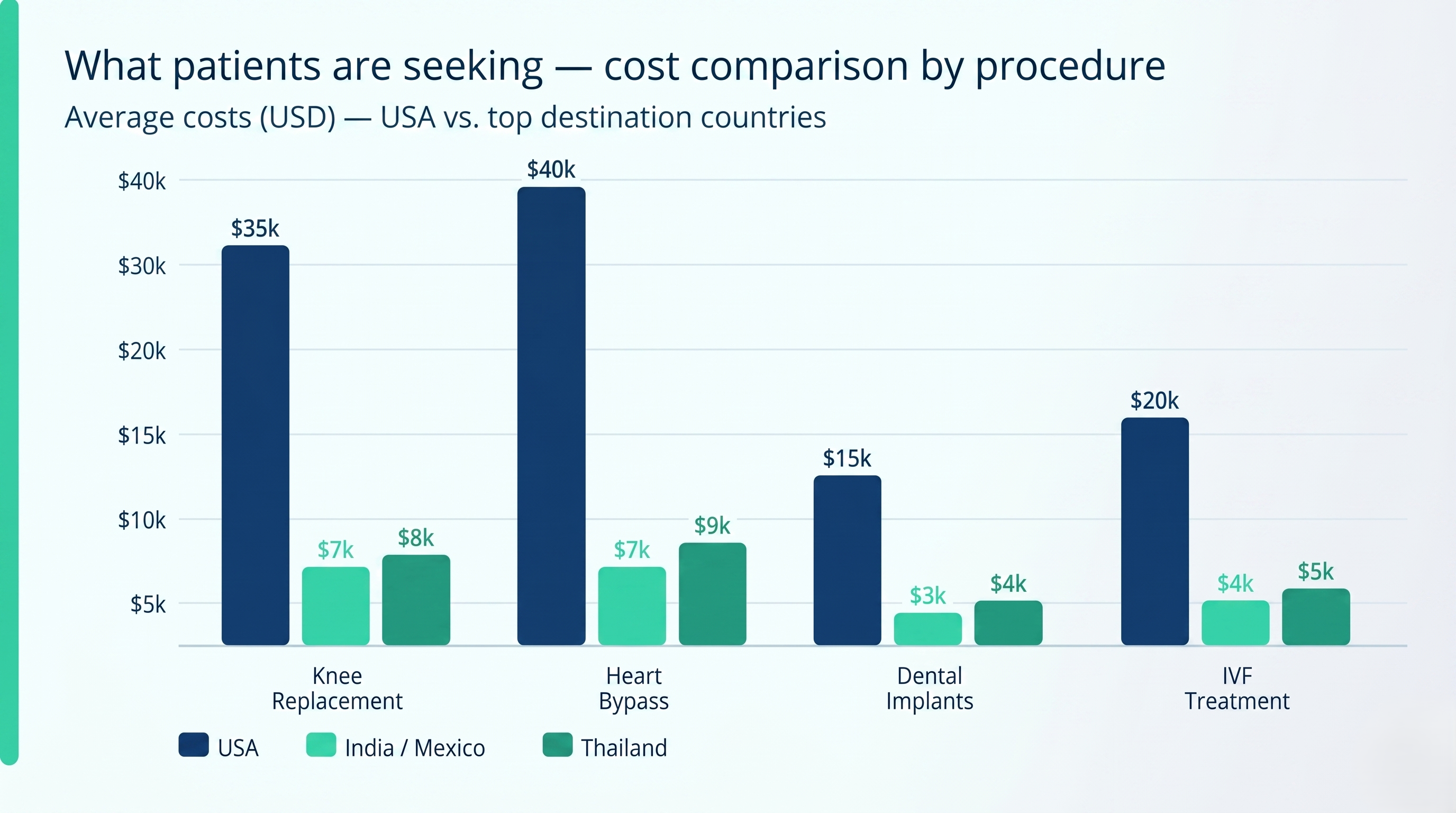
Medical tourists are not a monolithic group. They travel for a wide range of reasons and procedures. Cost savings remain the most commonly cited driver — patients can save 50 to 80 percent on major procedures such as hip replacements, cardiac surgery, dental implants, and cosmetic procedures when traveling to lower-cost destinations. A knee replacement that costs $35,000 in the United States may be performed at an internationally accredited hospital in India or Thailand for $6,000 to $8,000, with comparable or superior outcomes.
But cost is not the only motivator. Many patients travel for access to treatments not available or approved in their home countries, including certain stem cell therapies, experimental oncology protocols, and specialized reproductive medicine. Others travel for shorter wait times — a particular driver for patients in countries with public healthcare systems where elective procedures can involve waits of months or years.
Quality perception has shifted significantly in the last decade. Two organizations have played a defining role in that shift. Joint Commission International (JCI) — the global arm of the US-based hospital accreditation body — has set the benchmark for clinical quality standards at international hospitals, with accredited facilities required to meet rigorous protocols across patient safety, infection control, and care delivery. Alongside JCI, the Global Medical Tourism Association (GMTA) has emerged as a critical institution shaping the industry's professional standards and global reach.
The Role of GMTA in the Medical Tourism Ecosystem
The Global Medical Tourism Association is more than an accreditation body — it is the connective tissue of the international medical travel industry. GMTA serves a dual mandate: establishing and enforcing quality and ethical standards for medical tourism providers worldwide, and functioning as a global membership network that connects hospitals, facilitators, insurers, wellness providers, and destination management organizations under a unified professional framework.
For hospitals and clinics seeking to attract international patients, GMTA membership and accreditation signals credibility in markets where trust is the primary barrier to patient conversion. Patients researching care abroad are making high-stakes decisions with limited local knowledge — a GMTA - recognized facility immediately communicates that it has been evaluated against internationally accepted benchmarks for safety, transparency, patient communication, and after-care protocols.
For business consultants and healthcare investors, GMTA membership offers a strategic lens into the industry. The association publishes research on medical tourism trends, destination performance, and consumer behaviour that informs market entry decisions, facility investment strategies, and partnership development. Its global conferences and events are among the most important networking venues in the industry, bringing together hospital executives, government health ministries, insurance executives, and patient facilitators from across six continents.
Providers serious about competing in the international patient market should view GMTA engagement — both accreditation and active membership — not as a cost of doing business but as a revenue-generating investment that opens doors to referral networks, corporate wellness contracts, and insurance partnerships that would otherwise be inaccessible.
The Business Architecture of Medical Tourism
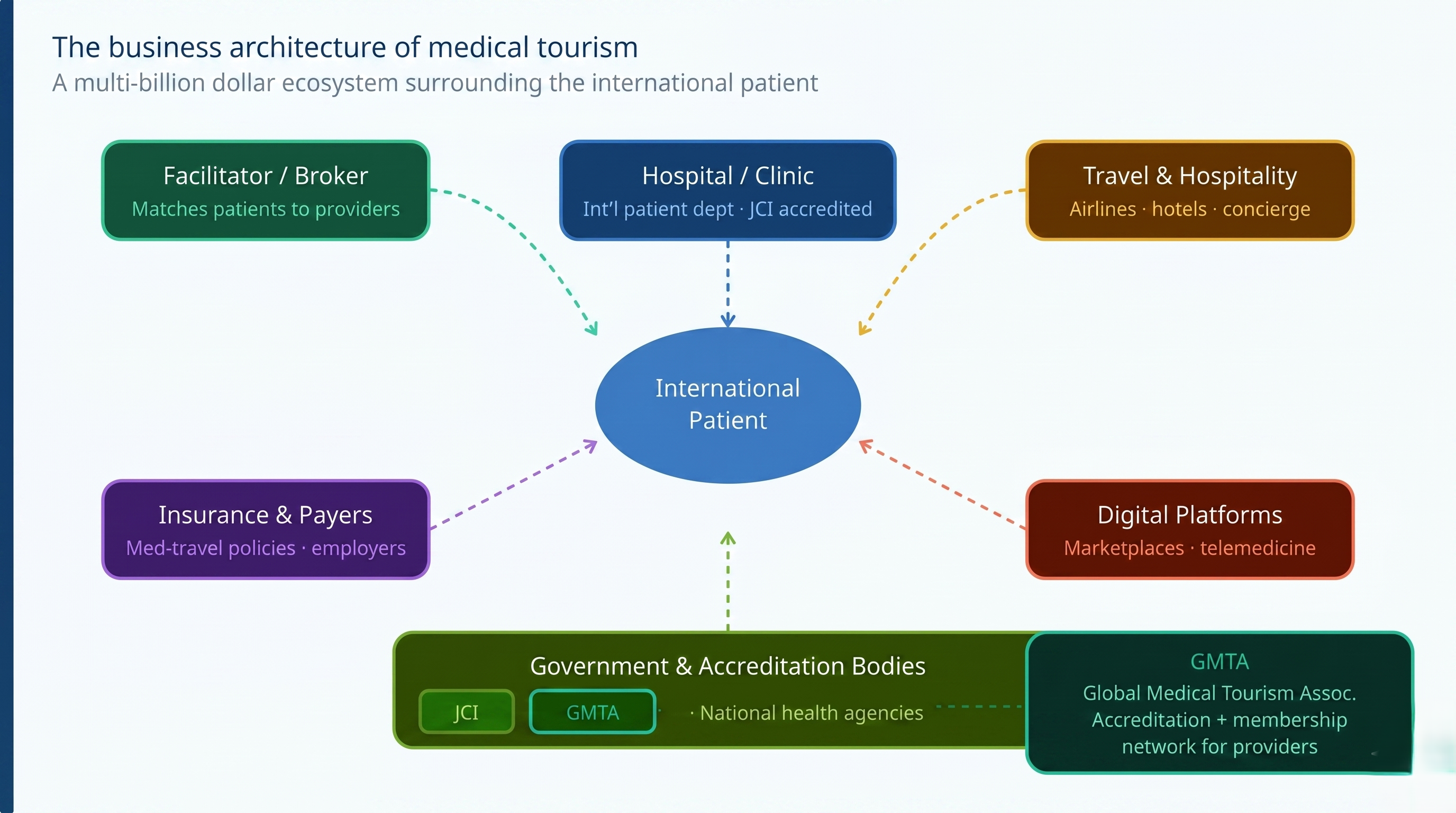
Medical tourism is not a single industry — it is an ecosystem. At its center are hospitals and clinics that treat international patients. Around them sits a growing network of facilitators and brokers who connect patients to providers, travel agencies that bundle medical packages with accommodation, insurance products designed specifically for cross-border care, telemedicine platforms that provide pre- and post-procedure consultations, and digital marketplaces where patients compare providers, prices, and outcomes.
For hospitals, international patients represent a premium revenue segment. They typically pay in advance, require no insurance negotiation, generate higher average revenue per patient than domestic payers, and often travel for high-margin elective procedures. A well-run international patient department — staffed with multilingual coordinators, supported by a robust telemedicine pre-screening process, and backed by GMTA and JCI accreditation — can generate 15 to 30 percent of a hospital's total revenue in top destination markets.
Governments have recognized this economic opportunity. Countries like Thailand, Singapore, India, and Jordan have developed national medical tourism strategies, offering incentives to hospitals that invest in international patient infrastructure, pursue globally recognized accreditation, and market their healthcare sectors as export industries. In several of these markets, GMTA has partnered directly with national health ministries to co-develop quality frameworks and promote destination competitiveness on the world stage.
Key Takeaway
Medical tourism is no longer a fringe market. It is a structured, growing, and increasingly sophisticated global industry governed by recognized standards bodies — led by JCI and GMTA — and supported by a multi-layered business ecosystem. Whether you are a hospital executive building an international patient program, an investor evaluating healthcare assets in emerging markets, or a consultant advising clients on cross-border care strategy, understanding the role of accreditation and professional membership in this industry is as important as understanding the clinical services themselves.
Thinking about entering the medical tourism market or strengthening your international patient program? A strategic market assessment — anchored in GMTA and JCI accreditation readiness — can help you identify the right positioning, target markets, and operational model to compete credibly and profitably in this $100 billion global opportunity.
Written by
MD Zee
Comments
Log in to join the conversation.
Loading comments…