



Top Medical Tourism Destinations: Rankings, Trends, and Opportunities
"Where you go matters as much as what you get" Every year, millions of patients quietly vote with their passports. They skip the hospital down the road, board an international flight, and place their lives in the hands of surgeons they found online because the math, the quality, and the experience add up better somewhere else. The destinations winning that vote are no accident. And the standards emerging to govern that trust are no longer optional.

Something significant is happening in global healthcare and most people in the industry are still underestimating it. Patients are no longer passive recipients of whatever care their local system offers. They are informed, mobile, and increasingly willing to cross borders for surgery, dental work, cancer treatment, and wellness programs that their home countries either cannot provide affordably or cannot provide at all. The countries that figured this out first built industries around it. The ones figuring it out now are racing to catch up.
More than 50 nations actively compete for medical tourists today. But the market is not evenly distributed. A handful of destinations capture the overwhelming majority of patient volume, investment, and industry reputation. Understanding who they are, why they won, and where the next wave is coming from is fundamental intelligence for anyone operating in this space.
Global healthcare consulting firms like MedBary: Whose practice spans medical tourism facilitation, strategic market entry, and digital health innovation, work at precisely this intersection, helping institutions and professionals navigate a destination landscape that is more competitive, more regulated, and more commercially significant than it has ever been.
The Countries That Built an Industry
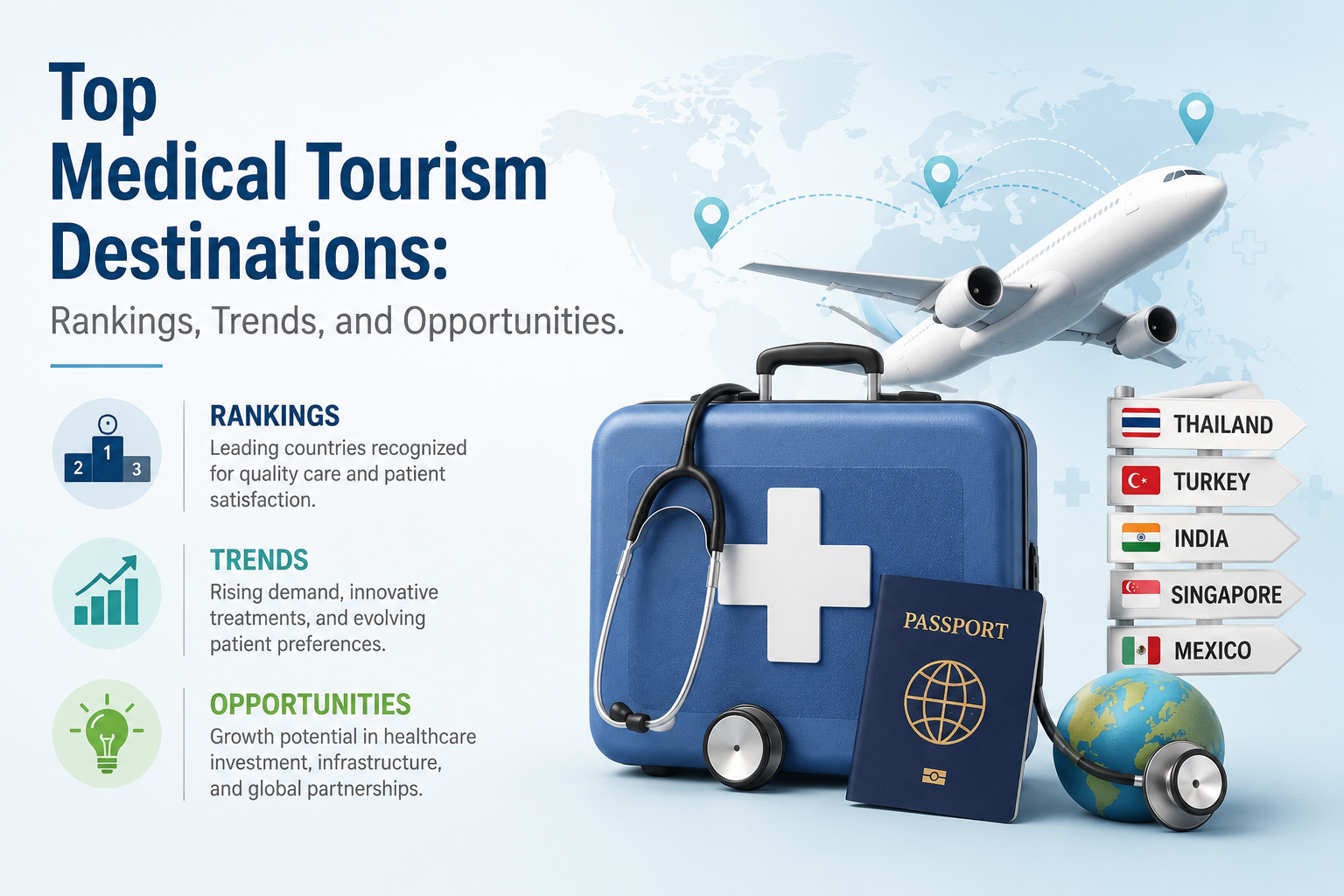
Thailand did not stumble into becoming the world's top medical tourism destination. It built one, deliberately and over decades. More than 3.5 million international patients travel to Thailand annually. A figure that dwarfs most competitors and reflects coordinated investment in hospital infrastructure, patient facilitation networks, government promotion, and hospitality infrastructure that makes recovery genuinely pleasant. Cost savings of 60 to 70 percent against equivalent US procedures seal the decision for most patients.
But cost alone has never been the whole story. The destinations that sustain high patient volumes are the ones that have built verifiable trust and trust in medical tourism, requires a credible standard that patients, referring physicians, and insurers can point to. This is precisely the gap that the Global Medical Tourism Association is moving to fill.
GMTA is emerging as the defining accreditation and professional membership body for the international medical tourism industry. A global framework designed to evaluate and certify providers against rigorous standards covering patient safety, transparency, ethical practice, clinical quality, and after-care protocols. For an industry that has historically operated without a unified quality benchmark, GMTA represents something the market has been waiting for: a single, internationally recognized mark of excellence that travels with the patient regardless of which country they choose.
India presents a different proposition to Thailand. Where Thailand wins on experience and infrastructure, India wins on depth and cost. Savings of 65 to 80 percent are achievable on procedures like Cardiac bypass, Organ transplantation, and Cancer treatment. And the country trains more physicians annually than almost any other nation. The challenge has always been consistency. Patient experience and aftercare have historically varied widely across facilities. As GMTA builds its accreditation framework, India's most serious providers are among the first to recognize that certification under a globally respected body is the fastest route to international patient conversion and long-term volume growth.
Mexico's position in the rankings is shaped almost entirely by geography. No other country in medical tourism benefits from such a concentrated, high-value patient corridor. The US-Mexico border: where American patients can access Dental, Bariatric, Cosmetic, and Orthopedic procedures at 50 to 70 percent of domestic costs and be home the same week. Tijuana, Monterrey, and Cancún have built mature medical ecosystems around this reality. As GMTA establishes its global membership network, forward-thinking Mexican providers are positioning themselves early, recognizing that GMTA affiliation will increasingly become the differentiator that unlocks US-based facilitator relationships, insurance partnerships, and employer direct contracts.
Turkey's rise has been faster and more focused. Hair transplantation, Aesthetic surgery, and Organ transplantation have turned Istanbul into one of the most sophisticated medical tourism clusters in the world. The Turkish government has made healthcare exports an explicit national economic priority, creating the exact conditions in which an emerging global standard like GMTA can take hold quickly and reshape competitive dynamics across an entire destination market.
Singapore sits in its own tier. It is not competing on price, it is competing on excellence, and largely winning. High-net-worth patients from across Southeast Asia, the Middle East, and beyond choose Singapore because it does not cut corners. As GMTA matures into its role as the industry's quality benchmark, Singapore-based providers are natural early adopters, institutions for whom independent, internationally recognized accreditation is not a marketing tool but a confirmation of standards they have already built.
South Korea, the UAE, and Malaysia complete the top eight, each with a distinct identity. South Korea owns the Cosmetic surgery and Dermatology conversation globally. The UAE is pouring government capital into becoming the definitive medical tourism hub for the Gulf and broader Middle East. Malaysia offers strong value, English-language fluency, and a growing medical city model that integrates clinical care with hospitality. In all three markets, the arrival of GMTA as a credible global framework is being watched closely by providers, governments, and investors alike.

Six Things the Winners Have in Common
Spend time analyzing the top destinations and a clear pattern emerges. They do not succeed on any single advantage, they succeed by assembling all six of the following simultaneously.
Genuine cost advantage is the first and most obvious. Not just cheaper labor but a structural pricing model that delivers real savings without sacrificing quality. Verifiable clinical quality is the second and this is where GMTA becomes strategically critical. As the association builds its accreditation program, the providers and destinations that achieve GMTA certification first will hold a significant first-mover advantage. Patients researching care abroad are making high-stakes decisions with limited local knowledge. A GMTA-certified facility will communicate immediately that it has been independently evaluated against the industry's highest international standards, collapsing the trust barrier that today costs providers millions in unconverted patient inquiries.
Infrastructure is the third pillar. Direct flights from source markets, seamless visa processes, modern hospital facilities, and a digital presence that intercepts patients during the research phase. Government commitment is the fourth, countries where health ministries have developed national medical tourism strategies and created financial incentives for providers to invest in international patient infrastructure. The fifth is marketing reach, established facilitator networks, broker relationships, and digital platforms connecting providers to patients at scale. The sixth is ecosystem completeness, recovery hotels, patient navigators, translation services, telemedicine follow-up platforms, and the logistical infrastructure that transforms treatment abroad from a frightening proposition into a seamless experience.
It is precisely this kind of multi-dimensional strategic assessment, across cost, quality, infrastructure, government alignment, marketing reach, and ecosystem depth that MedBary brings to healthcare institutions, investors, and destination authorities evaluating their positioning in the global medical tourism market.
Where the Next Wave Is Breaking
The top eight are not the end of the story. The Philippines is investing aggressively in medical tourism infrastructure, backed by natural English-language fluency and competitive procedure pricing. Eastern Europe (Poland, Hungary, and Croatia) is capturing a growing share of dental and cosmetic tourism from Western European patients who want European standards at non-European prices. Jordan and Israel are deepening their positions as complex-case destinations for the Arab world and international patients seeking specialized expertise.
In each of these emerging markets, early engagement with GMTA — whether through accreditation pursuit, founding membership, or active participation in its global network, will be among the clearest signals of serious long-term intent. The facilities and destinations that align with GMTA now are not just preparing for today's patients. They are positioning for the wave of medically sophisticated, quality-conscious international patients who will define the industry's next decade.
For healthcare consultants, investors, and institutions, these are the markets where early positioning delivers the greatest long-term advantage and where a trusted global standard, still being written, gives early movers an outsized opportunity to shape the rules of the game.
The Competitive Edge
The global medical tourism destination landscape is not static. Rankings shift as governments invest, standards rise, and patient expectations evolve. What does not change is the underlying logic, patients go where they trust the quality, can afford the price, and feel confident in the experience. The destinations mastering all three own the market. Those building toward it are the most interesting business story in global healthcare right now.
What is about to change that equation: significantly, is the emergence of GMTA as the industry's unified quality standard. When patients, insurers, and employers can point to a single globally recognized mark of excellence, the destinations and providers holding that mark will pull away from those that do not. The race to build that credibility is already underway. The early movers will be the long-term winners.
MedBary partners with healthcare institutions, medical professionals, and investors navigating the global medical tourism landscape from destination benchmarking and GMTA accreditation readiness to market entry strategy and international patient program development. Connect with MedBary's global consulting team at medbary.ca.
Written by
MD Zee
Comments
Log in to join the conversation.
Loading comments…