


Your Morning Cup and Your Heart: What the Research Actually Says
Caffeine has been quietly blacklisted from cardiology waiting rooms for decades — not because the evidence demanded it, but because nobody stopped to check. A string of large-scale studies just did, and what they found rewrites the advice millions of people have been given about their morning coffee.

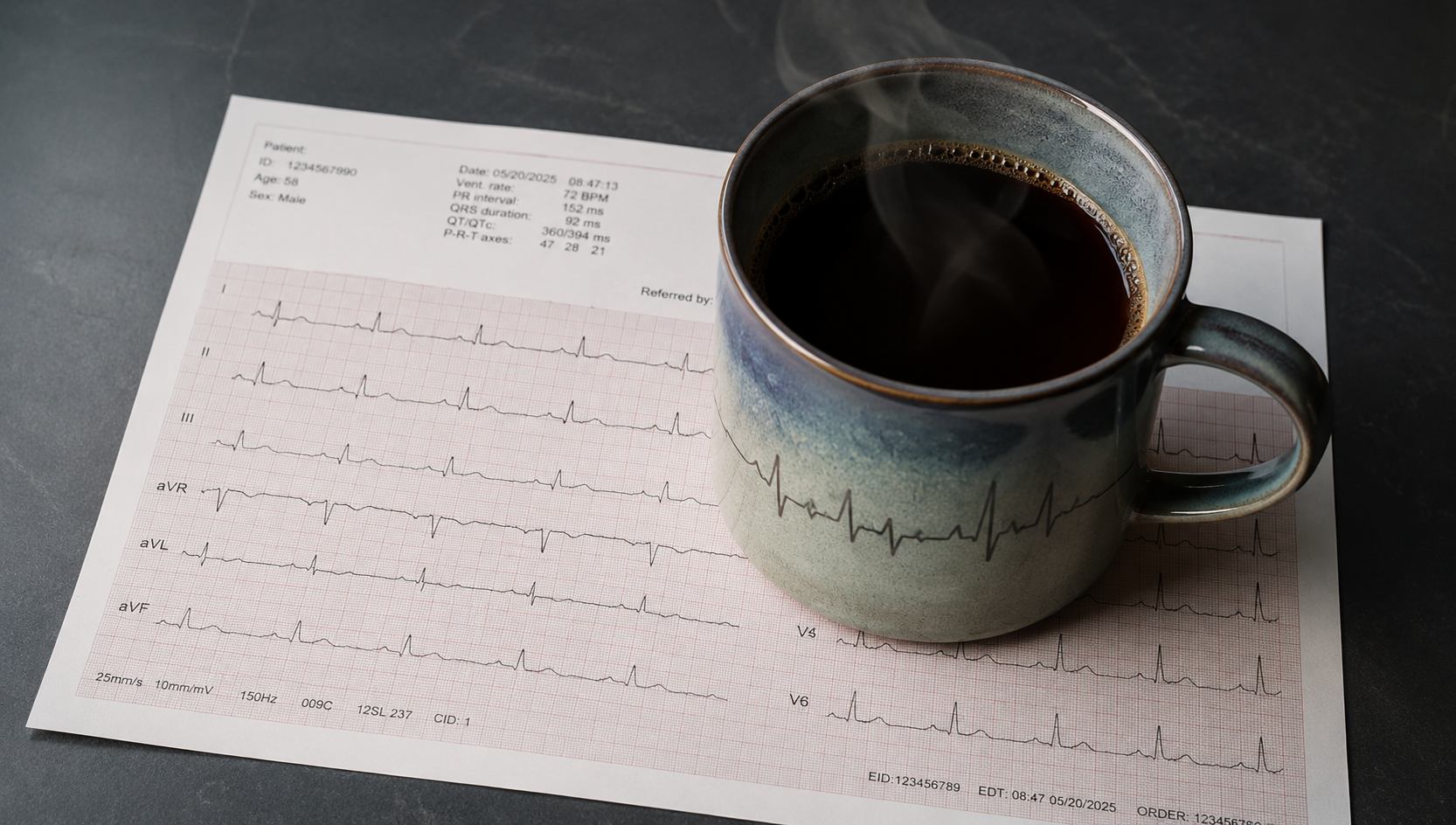
Why It Matters
A belief taught in clinics, repeated in waiting rooms, and absorbed by millions — examined under the light of actual data.
"One of the useful things about age is realizing conventional wisdom is often simply inertia with a candy coating of conformity."
— Anna Quindlen
Atrial fibrillation — an irregular, often rapid heart rate — affects tens of millions globally and carries serious consequences including stroke and heart failure. For years, the clinical consensus held that caffeine was a trigger and that patients with A-Fib, or those at risk, should eliminate coffee entirely. This recommendation was passed from physician to patient with the weight of settled fact.
The problem is that the evidence base for this warning was always thin. Epidemiological studies were conflated with causation. Anecdotal reports from caffeine-sensitive individuals were generalized to the broader population. Nobody asked the foundational question: does caffeine actually cause A-Fib, or had we simply assumed it must?
This matters because the consequences of bad dietary advice accumulate. Patients who gave up coffee on medical guidance may have surrendered a meaningful source of bioactive compounds — polyphenols, antioxidants, and anti-inflammatory agents — that a growing body of evidence links to heart health, neuroprotection, and longevity. Getting this right isn't academic; it has daily, measurable effects on quality of life.

Detailed Viewpoint
From Folklore to Pharmacology: Rethinking Caffeine's Cardiac Role
The assertion that caffeine provokes cardiac arrhythmias has roots in pre-modern pharmacology, when stimulants as a class were viewed with suspicion. Caffeine does, in controlled settings, mildly elevate heart rate and blood pressure. That physiological fact slid effortlessly — but incorrectly — into clinical doctrine. The leap from "caffeine is stimulating" to "caffeine causes A-Fib" turns out to lack the evidentiary support that medical guidance demands.
Contemporary large-scale studies find no credible causal link between moderate caffeine consumption and increased A-Fib risk. Some analyses even suggest a mild protective direction — an irony that underscores how dramatically this narrative has shifted. What researchers now understand is that coffee is not merely a caffeine delivery vehicle. It is a complex phytochemical matrix containing more than 1,000 distinct compounds, including chlorogenic acids and other polyphenols whose antioxidant and anti-inflammatory properties appear to contribute meaningfully to cardiovascular health.
The longevity data are among the most compelling. Research through USC's Keck School of Medicine tracked over 215,000 participants across multiple ethnicities over many years. Those who consumed two to three cups daily showed an 18% lower chance of dying during the study period compared to those who abstained entirely — a finding that held regardless of whether the coffee was caffeinated or decaffeinated. That detail alone is telling: if the benefit were about caffeine's stimulant effects, decaf would deliver nothing. Instead, it delivers nearly the same outcomes, pointing squarely at the non-caffeine constituents of coffee.
Cognitive protection is a parallel thread running through this literature. McGill University researchers examining data from nearly 8,500 older adults over nine years found that those in the moderate-consumption group experienced the slowest decline in reasoning and memory scores. Harvard-affiliated research following 6,000 subjects beyond age 50 for seven years associated moderate intake with a 28% lower risk of dementia. An Australian study tracking 227 adults found that increasing from one to two cups daily was linked to roughly an 8% decrease in executive function decline and a measurable slowing of beta-amyloid accumulation — the protein buildup central to Alzheimer's disease.
The Dose Principle
Toxicology's oldest law applies: dose determines outcome. One to four cups per day appears to occupy a favorable window — reducing inflammatory markers, supporting cardiovascular function, and protecting cognition. Beyond four cups daily, those benefits attenuate and reverse. This is not a reason to avoid coffee; it is a reason to drink it thoughtfully.
Yale research introduced another dimension entirely. Psychologists found that physical warmth — holding a warm cup of coffee — influenced social perception, making people judge others as more generous and caring. The ritual of coffee is itself embedded in social and psychological fabric. Its benefits are not reducible to biochemistry alone.
Where does this leave the comparison to tea? Harvard Health researchers note that both beverages carry meaningful polyphenol loads and that their health profiles overlap considerably. Green tea's catechins and coffee's chlorogenic acids work through partially different pathways, and both appear beneficial in moderate amounts. The honest answer is that neither clearly dominates the other — a conclusion that should comfort drinkers of either.
Individual variation remains real. A fraction of the population is genuinely caffeine-sensitive — experiencing palpitations, heightened anxiety, or sleep disruption even at low doses. For this group, decaffeinated coffee or tea may offer a path to the same phytochemical benefits without the stimulant burden. The point is not that everyone should drink coffee, but that the reflexive warning — especially regarding heart rhythm — was never as grounded as it sounded.

Citations & Credibility
This article synthesises findings from peer-reviewed research, academic medical institutions, and published population studies. Key sources:
USC Keck School of Medicine / Annals of Internal Medicine (2017)
Multiethnic Cohort Study, 215,000+ participants — coffee consumption and all-cause mortality across ethnic groups. Principal investigator: V. Wendy Setiawan, Associate Professor of Preventive Medicine.
McGill University Office for Science and Society (2024)
Analysis of UK Biobank data from 8,451 adults over 60 across nine years. Also references Harvard-affiliated dementia research (6,000 subjects, 7 years) and the Australian Imaging, Biomarkers and Lifestyle Study (227 adults, 10 years). Author: Joe Schwarcz, Director of McGill's Office for Science and Society.
Harvard Health Publishing — Caffeine, Memory & Cognition (2014)
Review of evidence linking moderate caffeinated beverage consumption to improved memory, thinking skills, and cognitive longevity. Published on Harvard Health Blog.
Yale University — Temperature and Social Perception (2008)
Published research from Yale's Department of Psychology demonstrating that physical warmth from a cup of hot coffee meaningfully influences interpersonal social judgements. Researchers: John A. Bargh and Lawrence E. Williams.
Harvard Health Publishing — Coffee vs. Tea (2023)
Comparative review of health outcomes associated with coffee and tea consumption, covering cardiovascular, metabolic, and cognitive endpoints.
PubMed — Caffeine and Cardiac Arrhythmia (2025, PMID 40626862)
Recent systematic analysis examining the relationship between caffeine intake and atrial fibrillation risk, contributing to the reassessment of long-standing clinical advisories.
All claims in this article are drawn from published research and institutional sources. Individual health decisions should be made in consultation with a qualified healthcare provider.
Topics
Editorial Note
This article is produced for general informational purposes and reflects a synthesis of published academic and medical research. It does not constitute medical advice and is not a substitute for consultation with a licensed healthcare professional. Individuals with existing cardiovascular conditions, including atrial fibrillation, should speak directly with their physician before making changes to caffeine or dietary habits.
Research citations are linked to original institutional and peer-reviewed sources. Editorial standards require that all factual claims be traceable to published evidence.

Written by
MedBary Team
Comments
Log in to join the conversation.
Loading comments…